TBILISI, May 21 – The deportation of Azerbaijani journalist Afgan Sadigov from Georgia was a serious press freedom case and a warning sign for anyone who still sees Tbilisi as a safe refuge for dissidents from the region.
This is not a new problem. Georgia’s record on Azerbaijani dissidents has been questionable since at least 2017, when investigative journalist Afgan Mukhtarli disappeared in Tbilisi and later turned up in custody in Azerbaijan. Mukhtarli said he had been abducted in downtown Tbilisi and secretly transferred across the border. Georgian authorities denied involvement, but the case badly damaged trust among Azerbaijani activists living in Georgia. DFWatch reported at the time that some Azerbaijani dissidents had already begun to feel unsafe in Georgia after the case.
Sadigov’s case now brings that old question back on the agenda. Sadigov, editor of Azel.TV, was first detained in Tbilisi on August 3, 2024, after Azerbaijan requested his extradition on accusations of threat and extortion. Georgia’s Ministry of Internal Affairs confirmed that he had been detained for possible extradition. His lawyer said the material sent from Azerbaijan contained general claims but no concrete evidence, and argued that Sadigov was being targeted as an independent journalist exposing political conditions in Azerbaijan.
A Tbilisi court placed him in extradition custody for three months. He later applied for international protection in Georgia, but the Migration Department rejected his request. Sadigov went on hunger strike in prison, and his lawyers and rights defenders warned that returning him to Azerbaijan would put him at serious risk.
The case took another turn in 2026. According to Index on Censorship, Sadigov was deported after being arrested at home on a charge of “insulting police” on social media, followed by a hearing at around 4 am and a court order sending him back to Azerbaijan with a three-year re-entry ban.
That is deeply troubling from a press freedom perspective. A democratic state has a duty when dealing with a foreign journalist to consider that they may face persecution if returned home.
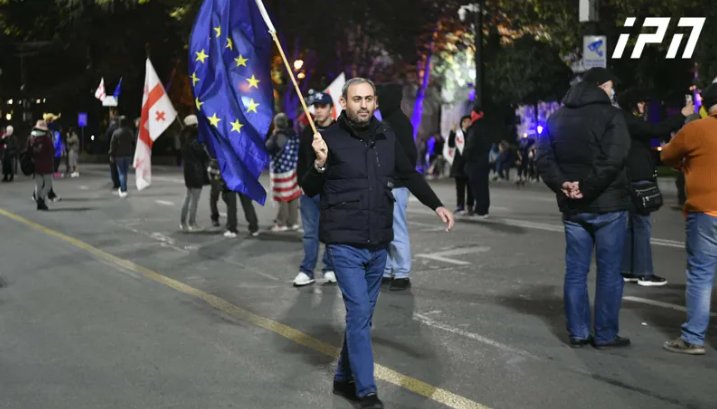
Meanwhile, there is also a Georgian side of the case that is more complex than many international summaries suggest. Sadigov was not only an Azerbaijani journalist living in Georgia. By 2025 and 2026, he had also become a visible participant in Georgia’s own anti-government protest scene. That visible role does not make the expulsion less alarming but may help explain why Georgian authorities treated him as a politically inconvenient non-citizen.
The case is not only about press freedom in Azerbaijan, but also Georgia’s handling of foreign critics and protesters, and the political crackdown that followed the 2024 parliamentary election.
Some international commentary has framed the case as proof that Georgia has newly ceased to be a safe haven for journalists escaping persecution. While this is an important concern, the timeline is factually incorrect. Index on Censorship wrote that “gone are the days when Tbilisi was safe for journalists escaping persecution.” But DFWatch and others were reporting years ago that the Mukhtarli case had already shaken that image.
That historical context does not make the Sadigov case less alarming. Georgia had already seen what happened when a journalist wanted by Azerbaijan was taken from Tbilisi and ended up in Baku. Despite a ruling by the European Court of Human Rights to put extradition on hold, and fully aware of the risks involved, it still went ahead.
Now, after Sadigov’s extradition, the case must not leave the public spotlight. The public has a legitimate interest in being properly informed of the handling of the case. The need for scrutiny is all the more important in light of the sloppy investigation into Mukhtarli’s abduction nearly a decade ago – which Georgian authorities have still not properly explained.
Public Defender Levan Ioseliani said after Sadigov’s deportation that his office would study whether the expulsion from Georgia had been lawful. His assessment is important, not the least since the ombudsman has proven to perform the role as a non-partisan rights defender diligently and with attention to facts. The public now deserves to know whether Georgia’s human rights institution believes the state acted within the law, and whether Georgia met its obligation to protect a journalist facing possible persecution.
DFWatch has asked the Public Defender’s Office whether its assessment of the Afgan Sadigov case has been completed. The office did not provide a direct answer, instead referring to the Public Defender’s website for published recommendations and reports.
This case also shows why historical memory matters in reporting on Georgia. It did not appear out of nowhere. DFWatch reported years ago that the Mukhtarli abduction had already undermined the role of Georgia as a safe refuge for Azerbaijani dissidents. Watchdogs and commentators may benefit from that earlier reporting, in order to avoid a too-neat story of sudden democratic collapse. In fact, it’s a problem that has been developing for years.
DFWatch has followed Georgia’s treatment of Azerbaijani dissidents since the Mukhtarli case in 2017. Support our independent reporting through our “Support us” page.