Georgia’s “crackdown” isn’t what the headlines suggest.
International coverage of Georgia’s recent detentions reads like a Cold War thriller. Words such as “purge,” “totalitarianism,” and “crackdown” are passed around as generously as khinkali at a supra. Once again, foreign audiences are dazzled by the imagery but left in the dark about what’s actually happening, and it doesn’t withstand much scrutiny.
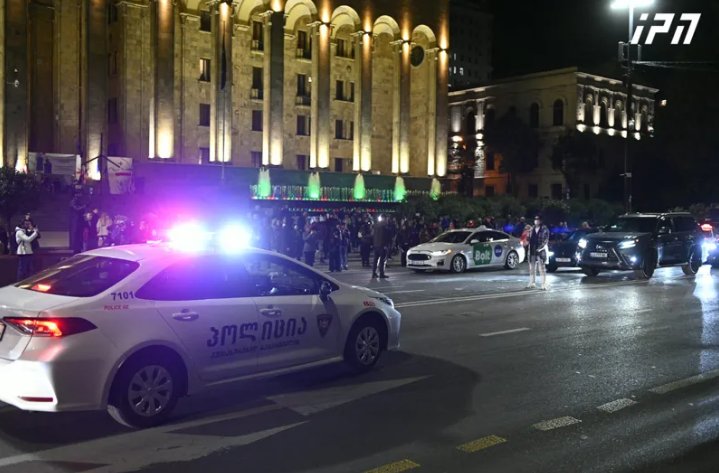
Blocking Tbilisi’s main street Rustaveli has become the focal point of activists recently. Can blocking the road be part of a protest? In a way, yes. Breaking rules can be a potent act of protest, because it provokes a reaction from the authorities. At a recent street protest in Portland, Oregon, against the police operations of U.S. Immigration and Customs Enforcement (ICE), a police officer told off a demonstrator who had parked their car across the road. “That’s a violation,” the officer said, and ordered the car removed. Portland has 650,000 residents, fewer than Tbilisi.
Road blocking is often part of stirring the public and bringing attention to a cause, and that’s fine. The problem starts when a movement uses deliberate disruptions, like blocking major roads, specifically to provoke a reaction, and then presents that reaction as if something entirely different were taking place.
This sleight of hand works by omission. For example, foreign reports say that “journalists were detained at a protest in front of parliament.” Omit one fact, that they were detained not for reporting but for participating in road-blocking or for covering their faces (which is restricted by law across much of Europe), and the story suddenly sounds like the plot of a dictatorship.
This does not absolve the Georgian Dream government of clumsiness. Rustaveli Avenue, Tbilisi’s main artery, has become the stage for opposition street theater largely because the ruling party made it one. In February, parliament, controlled by Georgian Dream, amended the law regulating demonstrations, tightening restrictions on where and how protests can occur. Then, on October 17, new administrative penalties were introduced: higher fines and short jail terms under an old Soviet-era statute that Georgian Dream had once promised to repeal. This all amounts to an indirect invitation for an opposition eager to find “buttons” to push that will bring out the regime’s imagined dictatorial nature.
Police and prosecutors, after months of near-total leniency, have begun applying the amended rules more consistently. Yet the resulting headlines suggest Georgia is descending into authoritarianism, when in reality, law enforcement is simply enforcing the new, stricter regulations on public assembly and traffic obstruction.
It’s not the first time Rustaveli Avenue has been the scene of confrontation. In spring 2011, President Saakashvili allowed opposition groups to occupy the street for months before ordering a violent crackdown on May 26 that left several dead. The location carries deep symbolism: the April 9 memorial stands as a reminder of Georgia’s 1991 independence struggle. Every generation of opposition has tried to tap into that emotional reservoir, and today’s street-blockers are no exception.
But symbolism is not substance. Much of the moral outrage abroad stems from Georgia’s well-organized NGO echo chamber. This week, Eurasianet ran an unsigned commentary claiming Georgian Dream has gone “totalitarian” and portraying the Rose Revolution era as a democratic high point, a narrative cut almost whole cloth from opposition messaging. Meanwhile, Amnesty International issued a press release that confused timelines and appeared to argue that protesters must be allowed to block traffic indefinitely, as if reopening a main avenue were an act of tyranny.
Such logic wouldn’t pass in any Western capital. In London or Berlin, police would never allow protesters to shut down central roads every evening. In Georgia, demonstrators freely rally on sidewalks and public squares, but blocking Rustaveli has become the ritual centerpiece precisely because it isn’t permitted. The aim is confrontation, to produce images that can be broadcast abroad as “evidence of repression.”
That doesn’t mean the government is without blame. Some of the new administrative measures are indeed heavy-handed, and police sometimes overreact. But that’s one side of the story. The other is that many protesters are deliberately testing legal boundaries to sustain a narrative of “resistance to dictatorship,” a narrative Western audiences are eager to believe.
What’s missing from NGO and media coverage is historical proportion. Under the United National Movement government, administrative sanctions were used far more aggressively, and against an opposition movement with broad, popular support, something that the current well-choreographed protests seem to lack. President Saakashvili tolerated several months of road blockage on Rustaveli Avenue in 2011, but when he’d had enough, he came down hard on the protesters. People died.
Today, the dynamic is mostly reversed. With important exceptions, like “the Gavrilov Night,” violence tends to originate with anti-GD protesters, while the law enforcement has shown restraint, responding mostly with brief detentions and fines. These may be unpleasant, but they’re not “totalitarian.” They are legal instruments found in every democracy, and they should be judged by the same standard applied elsewhere.