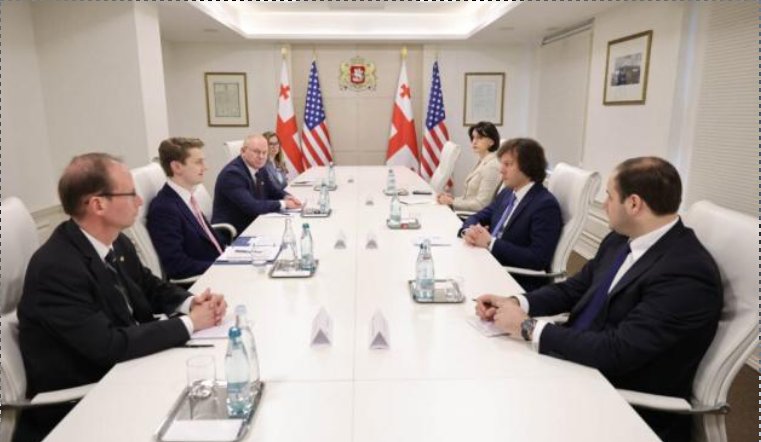
TBILISI, June 2 – Washington says it is ready to move relations with Georgia into a new phase after a State Department delegation held high-level meetings in Tbilisi last week.
But it also says political stability, a functioning opposition and a good climate for American investment will be needed, Rezonansi reported.
The U.S. delegation, which visited from May 25 to 29, included Charles Yockey from the Office of the Secretary of State and Peter Andreoli from the State Department’s Bureau of European and Eurasian Affairs, Office of Russian and Caucasus Affairs.
The delegation met with government officials, opposition representatives and the Georgian Orthodox Church. Rezonansi reported that it did not meet representatives of Tbilisi’s non-governmental organizations, which analysts linked to President Donald Trump’s domestic policy toward so-called NGOs.
In a statement released three days after the visit, the U.S. Embassy said the delegation met Prime Minister Irakli Kobakhidze, Vice Prime Ministers Maka Botchorishvili and Mamuka Mdinaradze, and other government officials to discuss ways to improve bilateral relations.
The embassy said the delegation shared the Trump administration’s readiness for a “constructive, future-oriented relationship” and interest in opening a new stage based on mutual respect, shared interests and honest dialogue between sovereign partners.
The statement said the two sides discussed possible areas of alignment, including commitment to national sovereignty, a fair economic environment, resilience against harmful outside influence and shared fundamental values.
“The delegation discussed concrete steps that the Georgian government can take and that will help us achieve this goal,” the embassy said.
The embassy also addressed Georgia’s political opposition. It said a functioning democracy needs an opposition that engages with state institutions to represent the voters who supported it. It added that political stability and real opposition representation are among the factors that make Georgia a reliable partner for American investment, security cooperation and long-term strategic partnership.
Georgia’s ruling Georgian Dream party welcomed the visit with cautious optimism. Kobakhidze said his government is ready to renew the strategic partnership with the U.S. “from a clean sheet” and with a concrete roadmap. He said the reset must be based on justice.
“We have declared our position that we are ready to renew the strategic partnership with the U.S. from a clean sheet and with a concrete roadmap,” Kobakhidze said.
He also contrasted the Trump administration’s approach with that of the previous U.S. administration, saying the earlier approach had encouraged opposition parties not to use their parliamentary mandates.
Georgian Dream MP Tengiz Sharmanashvili said the Georgian side had long been ready for real steps toward strategic partnership, but that tangible areas such as the economy had been missing. He said talk of investments and mutual interests was a positive sign.
The opposition read the embassy statement in different ways. Some saw it as a message to the government to take concrete steps to put the country back on democratic tracks. Ana Buchukuri, an MP from the For Georgia party, said opposition parties cannot refuse parliamentary mandates and also refuse to take part in elections.
Analyst Petre Mamradze told Rezonansi that the U.S. still appears to be watching what steps the Georgian government will take before a full reset. He said talks and visits were positive, but Georgia must be careful not to take steps that harm its national interests.
Analyst Vakhtang Dzabiradze commented that the U.S. may restore some level of partnership because the Caucasus region and Georgia are important for Washington. But he added that this would not mean the U.S. would ignore Georgia’s internal political situation.
“I do not rule out that there may be serious results not only at the level of statements, but that the partnership may be restored to some extent,” Dzabiradze said. “But this does not mean that the U.S. will close its eyes to everything.”