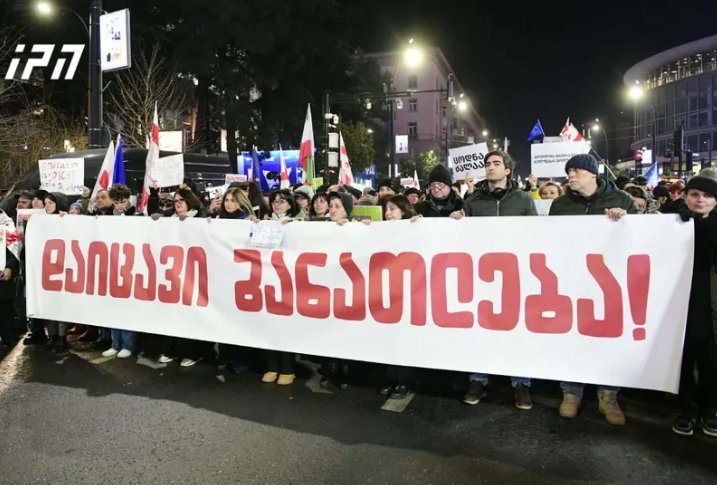
TBILISI, January 25 – Hundreds of protesters marched through central Tbilisi on Friday evening to oppose the Georgian Dream government’s planned education reform, turning the latest policy debate into a street protest led by academics and students.
The march, titled “Protect education,” began near the Tbilisi Philharmonic Hall and moved toward the Parliament of Georgia, where the demonstration continued later in the evening. Participants carried Georgian flags and banners reading “Knowledge is power” and “Our knowledge is not for sale.”
Those taking part included university professors, school teachers, and students, according to organizers. The protest targeted reforms announced by the ruling Georgian Dream party, which has said it plans wide-ranging changes to the education system. The government has framed the reforms as modernization, while critics argue they threaten academic independence and education standards.
Friday’s march is part of a broader campaign by educators and civil society groups who say the reform has been developed without proper consultation with the academic community. Organizers have accused the government of sidelining professional expertise, though Georgian Dream officials have defended the reform as necessary and lawful.
At the protest, organizers also announced a follow-up event. They said a public forum titled “Protect education” will be held on January 31 at Expo Georgia, under the leadership of former president Salome Zourabichvili. The forum is expected to bring together educators, students, and public figures to discuss the future of Georgia’s education system.
The demonstration remained peaceful, with no reports of clashes or arrests. As in previous protests, participants emphasized national symbols and civic messaging rather than party slogans.
The Georgian Dream government’s education reform has become one of the most contested domestic issues in the country in recent months. At the university level, the plan proposes merging duplicate faculties under a “one city, one faculty” rule, replacing the flat per-student grant with a state-order funding model tied to national priorities, and sharply increasing pay for full-time professors, with a minimum salary of 10,000 lari plus performance bonuses. The plan also shortens degree programs to a three-year bachelor’s and one-year master’s track and seeks to turn Kutaisi into a second higher-education hub alongside Tbilisi.
In public schools, the reform allows a shift from a 12-year to an 11-year system, letting students graduate and enter the workforce earlier. Officials say a twelfth year will still be available through private schools or special state-funded programs for those aiming to study abroad. Supporters argue the changes will better match education with labor market needs, reduce inefficiencies, and address staff shortages, while cutting oversized administrative structures at universities.
Critics warn the reform could weaken academic freedom and pull Georgia away from European education standards. They argue that consolidating faculties risks politicizing staffing and concentrating control over teaching and research. Others say reducing school years and degree length may limit international mobility and widen inequality between students who can and cannot afford private education. While some experts agree the current system has serious flaws, they caution that the scale and centralization of the reform could permanently reshape Georgia’s education system.