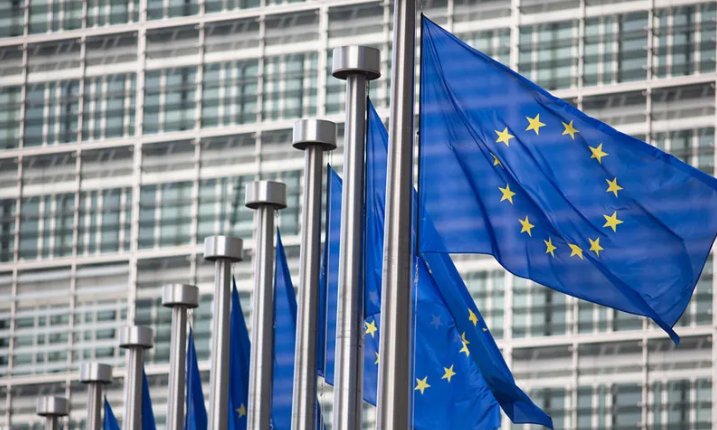
TBILISI, October 13 – A pro-government civic group in Georgia has called for a referendum to decide whether the country should continue seeking membership in the European Union.
The group, United Neutral Georgia, argues that a newly adopted EU strategy on LGBT rights crosses a “red line” for Georgia’s relations with Brussels.
The European Commission approved the LGBT Equality Strategy for 2026–2030 last Friday. According to the EU’s official statement, the plan aims to protect LGBT people from harmful practices and hate-motivated crimes, strengthen equality-promoting institutions, and ensure participation from civil society, member states, and other stakeholders. It also reaffirms that equality and non-discrimination are “fundamental rights” enshrined in the EU’s treaties and charter.
United Neutral Georgia denounced the document as a “treacherous plan drafted by the deep state,” claiming that it promotes legal gender change procedures for minors and undermines traditional values. The group insists that the new EU policy is mandatory not only for member states but also for candidate countries such as Georgia, which obtained EU candidate status in December 2023.
In its statement, the organization demanded that the Georgian government “urgently reassess” the country’s 2030 strategy for EU accession and begin public consultations leading to a referendum. “Through a referendum we must find out whether the Georgian people agree for our country to join such a European Union,” the group said. It called on Georgian Dream to let the referendum results guide the country’s future course.
The group did not specify whether the proposed referendum would be legally binding or advisory. Georgia’s constitution does not automatically make referendums binding, but in practice, a vote of this kind would carry enormous political weight in the country’s polarized political landscape.
But several analysts are skeptical that there will be a referendum. Vakhtang Dzabiradze told Rezonansi newspaper that the proposal is part of a propaganda campaign rather than a serious policy initiative. He said the authorities would never risk holding such a vote because “it is obvious that the majority would vote in favor of Europe.” According to Dzabiradze, the government’s allies are using the LGBT issue to shift attention from domestic controversies, including recent arrests of academics. “This is about redirecting the conversation,” he said, adding that a referendum would eliminate a convenient propaganda tool.
Another analyst, Zaal Anjaparidze, said he believes the referendum idea likely originated within United Neutral Georgia itself and may not be endorsed by Georgian Dream. He argued that the ruling party “is not in a position to complicate relations with Western partners” by openly questioning Georgia’s European course. Calling such a referendum, he said, “would mean admitting that we are abandoning the pro-Western path.”
Anjaparidze made a comparison to Moldova’s recent referendum, in which voters endorsed continuing EU integration, and noted that referendums are “a democratic instrument through which governments can seek a mandate for strategic decisions.” In Georgia’s case, he said, the call for a vote expresses opposition to any EU demand that Georgia repeal its own legislation restricting “LGBT propaganda” or legalize gender reassignment for minors, as the EU’s new five-year strategy describes.
He also pointed to comments made by Sweden’s foreign minister, who recently said that LGBT rights would be “a leading issue” when assessing Ukraine’s progress toward EU membership. According to Anjafaridze, that statement shows that Brussels is serious about monitoring LGBT policies in candidate countries, including Georgia. “Whoever tries to downplay it is wrong,” he said.
Dzabiradze believes that if a referendum did take place, most Georgians would vote for EU integration. He warned that the authorities could then claim that any anti-European outcome merely reflects the “will of the people,” allowing them to deflect responsibility.
Anjaparidze, on the other hand, said that if voters rejected EU membership, the government could use that result to “cut ties with the EU” and quietly dismantle the current integration policy. He suggested that such a development could even lead to changes in Article 78 of the Georgian Constitution, which commits the state to achieving full integration with the European Union and NATO.
Changing Article 78 would require parliamentary approval by a constitutional majority, meaning at least three-quarters of MPs must support it. Anjafaridze noted that if Georgian Dream were to win that kind of majority in future elections, it could theoretically amend or repeal the clause following a negative referendum outcome. “That would probably require new parliamentary elections,” he said.
However, he added that if voters reaffirm Georgia’s European course, the current policy would continue, and the opposition would gain leverage to pressure the government to meet EU requirements more consistently.