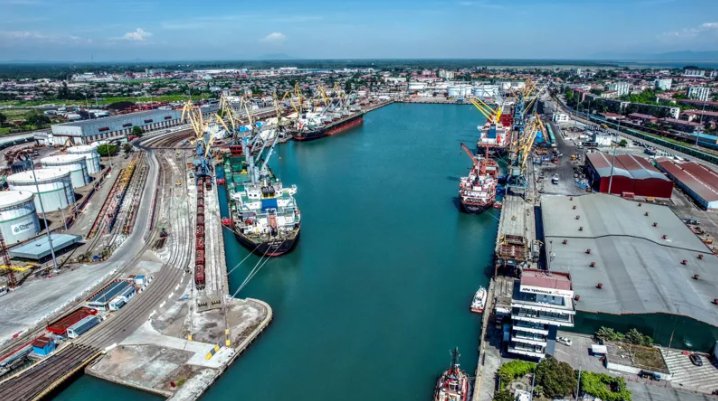
TBILISI, May 21 – A new study reveals that key parts of the business sector in the port city of Poti are controlled by just a handful of business groups.
Georgia’s Black Sea port city of Poti is one of the country’s gates to the world. Cargo, fuel, grain, fish, terminals, warehouses and transport routes all pass through this small coastal city. That makes Poti a strategic asset, not only for Georgia’s economy, but for regional trade.
According to a new study by Transparency International Georgia (TIG), Poti’s key economic sectors are concentrated in the hands of just a few business groups which connections in politics, including ruling party donors, current and former officials, and companies linked to Russian or offshore interests.
The study looked at publicly available records, including company registry data and state procurement information. It focused on four areas: fishing, ports and terminals, construction and infrastructure, and food production.
One of the clearest examples is fishing. TIG says only five companies hold strategic fishing licenses in the Black Sea, and that all of them had their exclusive licenses extended by the state until 2036. People linked to those companies donated about 1.49 million lari to political parties, including 1.28 million lari to the ruling Georgian Dream party, according to the watchdog.
TIG names several current and former political figures among people with business interests in Poti, including Georgian Dream MPs and former local officials. The watchdog says this raises questions about the overlap between political office, party donations and access to strategic assets. DFWatch has not independently verified all company links and donation records cited in the report.
TIG says one group of companies received a major tax benefit. According to the watchdog, the state reduced 5.4 million lari in liabilities for companies linked to the group to 160,000 lari through tax agreements. TIG says this raises risks linked to conflict of interest, illegal gifts and hidden assets.
The report also mentions Russian and offshore links in the port city’s economy. TIG says three Russian citizens, six dual Georgian-Russian citizens and one Russian company are connected to strategic terminals in Poti. It also says seven major companies have owners linked to offshore jurisdictions including Cyprus, Gibraltar and the British Virgin Islands.
Poti sits on the Black Sea and plays a role in wider trade routes between Europe and Asia. Who controls its terminals, logistics companies and port-related land is therefore a matter that extends far beyond the city itself.
TIG says the pattern points to oligopoly, weak transparency and political loyalty as a business advantage.
The watchdog says specific persons and companies in the sectors it studied donated 5.4 million lari to political parties. Georgian Dream, its ally People’s Power, and Salome Zurabishvili’s 2018 presidential campaign received 4.67 million lari, or about 86.5% of that amount.
The United National Movement also received donations in 2012, when it was still in power, according to the report.
Because the blog post does not include responses from the people or companies named, DFWatch is presenting the findings as watchdog claims, not established conclusions.