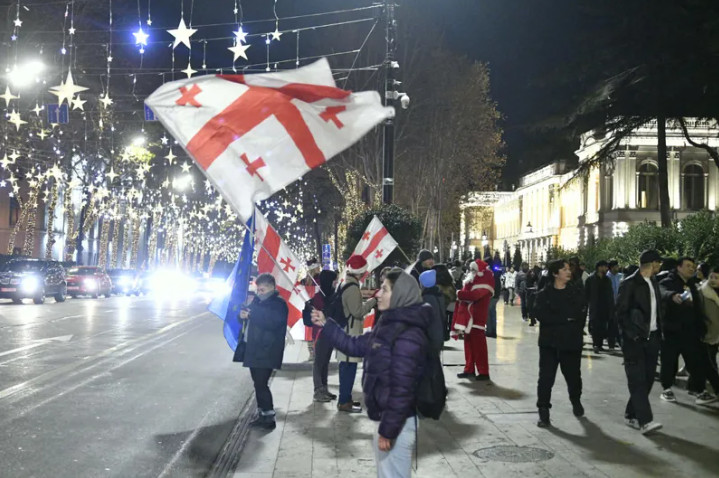
TBILISI, January 2 – Georgia welcomed 2026 with the usual New Year sparkle, but also with the same political tension that has kept nightly protests going in central Tbilisi.
On Wednesday evening, December 31, protesters remained gathered outside the country’s parliament, where they have been gathering daily for over a year. Their core demands stayed the same: new parliamentary elections and the release of people detained during protest-related events.
Late that night, Georgia’s Patrol Police Department director, Levan Maisuradze, went to the rally and personally explained recent amendments to the Law on Assemblies and Demonstrations, adopted on December 12. He warned that the new rules would be enforced “with the full severity of the law,” including an obligation to notify the Interior Ministry in advance in cases where a gathering is held in a pedestrian zone. The amendments also spell out new restrictions on “artificially” blocking pedestrian areas and lay out administrative detention of up to 15 days for participants and up to 20 days for organizers in certain cases, with repeat offenses potentially triggering criminal liability.
Protesters objected at the scene, saying they would not comply with the amendments. Father Dorote, an outspoken cleric in the Georgian Orthodox Church, also challenged police on how, in his view, the protesters were blocking the public.
Just after midnight on Thursday, January 1, former president Salome Zourabichvili appeared at a New Year gathering on Rustaveli Avenue, the capital’s main boulevard, where demonstrators were marking the start of 2026.
Among the official addresses were speeches by Prime Minister Irakli Kobakhidze, who issued a New Year address, while President Mikheil Kavelashvili also delivered a holiday message. Georgian Orthodox Church Patriarch Ilia II released a New Year greeting as well.
The government’s Christmas market was installed in a new location this year, at First Republic Square, about a kilometer north of where last year’s festive village was located, which was adjacent to the political rallies at parliament.
Among opposition voices, opera singer Paata Burchuladze posted a New Year message saying he was congratulating, among others, people he described as “prisoners of conscience” and “political prisoners,” and those greeting the New Year on Rustaveli Avenue. He also wrote that he believed 2026 would bring victory for those fighting for what he called Georgia’s European future.