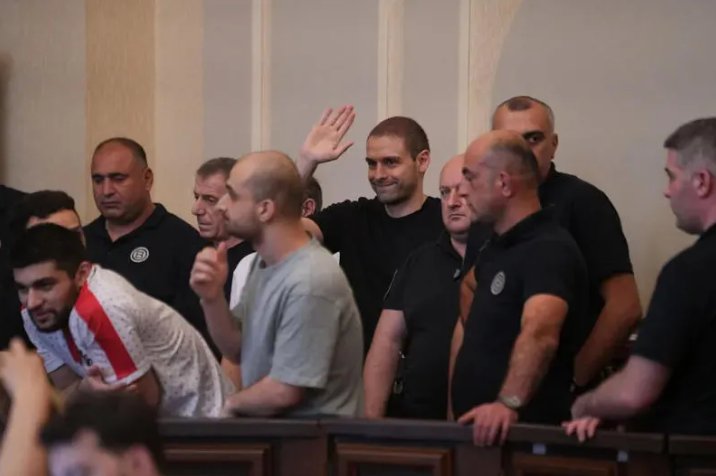
TBILISI, April 17 – A Georgian appeals court on Friday upheld the two-year prison sentences of actor Andro Chichinadze, comedian Onise Tskhadadze and nine other defendants in a closely watched case.
All defendants were arrested in December, 2024, in connection with anti-government protests.
The case has drawn international attention, with the International Federation of Actors last week calling on Georgian authorities to release Chichinadze immediately. The actor is well-known within Georgia and has a role in the upcoming Liam Neeson film Hotel Tehran, playing a U.S. Marine.
Tbilisi Court of Appeals left unchanged the first-instance verdict against 11 men: Andro Chichinadze, Onise Tskhadadze, Jano Archaia, Ruslan Sivakov, Luka Jabuia, Guram Mirtskhulava, Valeri Tetrashvili, Giorgi Terishvili, Irakli Kerashvili, Revaz Kiknadze and Sergei Kukharchuk.
The judge read the decision after hearing final statements from several of the convicted men earlier in the day.
The legal dispute deals with how to classify the charges. Prosecutors had wanted the defendants convicted under the article covering participation in organized group violence, which carries a sentence of four to six years in prison. But both the trial court and now the appeals court cleared them on that count and instead found them guilty of active participation in group action that disrupted public order.
The defense had asked for full acquittal, while the prosecution had appealed for conviction on the more serious charge. Neither side got what it wanted.
This leaves the original sentence intact: two years in prison for each defendant. Interpressnews reported that the 11 men will complete their two-year sentences in about eight months.
Before the ruling, former President Salome Zourabichvili arrived at the appeals court and said she had no grounds for optimism about Georgia’s court system, though she added that people could still have hope in God.
In the final statements, Tetrashvili said the case had been stitched together as political repression dressed up as justice. Tskhadadze said he did not want either silence or loyalty to Georgian Dream. Chichinadze told the judge that he was not asking for anything personally, but said the broader principle of justice demanded a fair ruling.