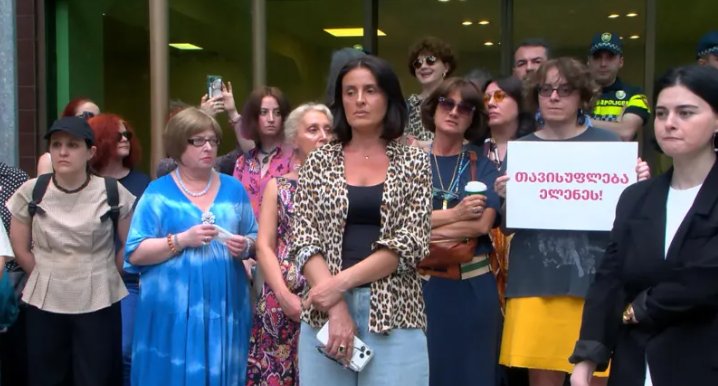
TBILISI, June 17 – The lawyer of jailed Georgian opposition politician Elene Khoshtaria warned Wednesday that her condition has sharply worsened. But prison authorities denied that she was being denied proper care.
Khoshtaria, one of the leaders of the opposition party Droa and the Coalition for Change, has been held in prison for about 10 months.
Her lawyer, Shota Tutberidze, said she has severe joint pain and increasing difficulty moving. At times, he said, she cannot write and needs a walking stick to move around.
Tutberidze said the problems became visibly worse about four months ago. He accused the prison’s medical staff and management of providing sporadic and ineffective treatment without producing a clear diagnosis or treatment plan.
According to the lawyer, doctors at a Turkish clinic who previously treated Khoshtaria warned that without appropriate treatment, her condition could cause irreversible damage and might eventually leave her unable to move without a wheelchair.
He said recommendations from the Turkish doctors were given to the medical staff at the No. 5 women’s prison about two months ago. He also said a request for a treatment plan and a meeting with prison officials had gone unanswered for two weeks.
The Special Penitentiary Service rejected the lawyer’s account as disinformation.
It said Khoshtaria was receiving uninterrupted access to medical services and had been examined by a cardiologist, neurologist, ophthalmologist, gynecologist, psychiatrist and rheumatologist. It said she had undergone several tests, including MRI scans of her spine and spinal cord.
The service said most of her diagnoses existed before she entered prison and involved chronic conditions that can periodically worsen. It insisted that her health had not deteriorated in custody.
According to the agency, Khoshtaria saw a rheumatologist on June 5, received recommendations and treatment, and had another consultation scheduled for Wednesday.
Tutberidze later challenged that response. He said the rheumatologist visit had not been arranged before his news briefing and accused prison officials of moving only after the case became public.
He acknowledged that Khoshtaria had previous health problems but said the current symptoms were new, more severe and had emerged during her imprisonment.
Khoshtaria’s party, Droa, also accused the prison service of treating isolated symptoms rather than providing systematic care.
Opposition leaders accused the authorities of endangering Khoshtaria’s health, while European Parliament member Rasa Juknevičienė called for her release and said she risked irreversible harm without treatment.
The European Parliament also adopted a report Wednesday calling for Khoshtaria’s immediate and unconditional release and the removal of what it described as politically motivated charges against her.
Prison authorities, however, maintained that Khoshtaria was receiving all necessary care and urged politically interested figures to stop spreading what they called false and unverified information.
Khoshtaria has a background as a government official during the years when the United National Movement was the ruling party, with Mikheil Saakashvili as president.
She previously used a hunger strike as a political protest. In June 2025, she spent three days outside the parliament building in Tbilisi, initially protesting the jailing of opposition figures and later saying she would stop if opposition parties jointly boycotted the October local elections that year. She ended the hunger strike after eight parties signed on, although two major opposition groups stayed out.