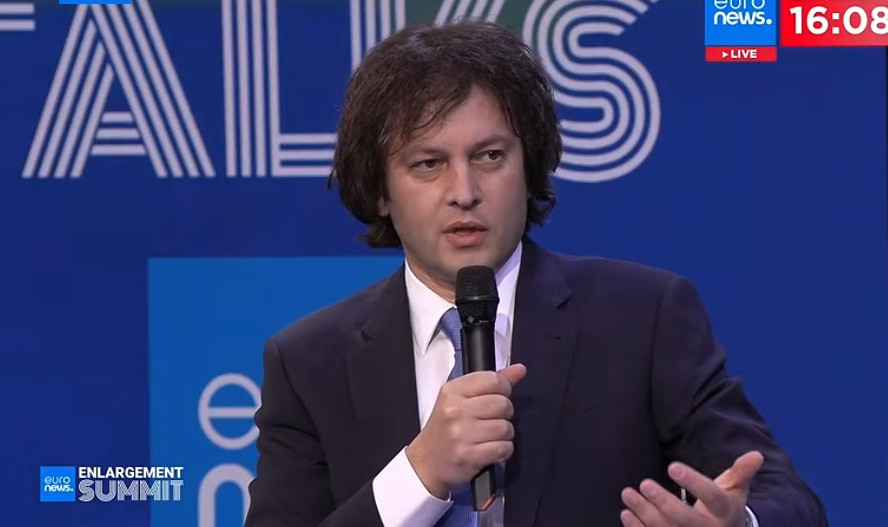
TBILISI, November 10 – Georgian Prime Minister Irakli Kobakhidze used a live Euronews interview in Brussels to claim that his government still aims for the country to join the European Union, while rejecting much of the EU’s criticism as politically motivated.
The unusually combative conversation took place November 3 at the Euronews Enlargement Summit, where leaders from EU candidate countries were questioned about their progress toward membership. The event also featured leaders from Albania, Armenia, Moldova, North Macedonia and other countries involved in the enlargement debate.
Euronews Europe editor Maria Tadeo repeatedly pressed Kobakhidze on how Georgia could restart its stalled accession process while refusing changes sought by Brussels.
Kobakhidze said Georgia remained committed to membership but accused the European Commission of using first candidate status and later accession talks to “blackmail Georgia, to blackmail the Georgian society.”
He also rejected the Commission’s criticism of democratic backsliding, saying: “This report is fake, everything is fake.” Instead, he proposed an open public debate with Commission representatives about democracy, the rule of law and disputed Georgian legislation.
Tadeo challenged him over laws regulating foreign-funded organizations, citing Venice Commission recommendations that they be repealed.
Kobakhidze refused that argument, saying the legislation complied with European standards and calling the Venice Commission’s assessment “fully political.”
Asked why Georgia wanted to join an EU whose institutions he was criticizing so strongly, Kobakhidze said: “We are optimistic that they will change.”
He compared the dispute to Georgia’s Soviet experience, saying the country did not want a relationship in which an outside center simply issued instructions.
Georgia applied for EU membership in March 2022 alongside Ukraine and Moldova. That June, Ukraine and Moldova received candidate status, while Georgia was bypassed in that round and told to complete additional reforms first. Georgia eventually received candidate status in December 2023.
Kobakhidze argued during the interview that later Commission assessments showed Georgia performing better than some countries that had advanced faster through the process, a point that has spurred vigorous debate in Tbilisi about possible causes and implications.
Georgia’s Constitution also requires state bodies to work toward membership in both the EU and NATO. That provision was added under Georgian Dream during the constitutional overhaul begun in 2017, and many viewed it as a safeguard against any future government abandoning the Euro-Atlantic foreign policy direction.
The accession process effectively stalled in 2024 after EU leaders said Georgian government policies were moving the country away from membership criteria. Georgian Dream later announced it would not itself seek the opening of accession talks before 2028, while saying it would participate if Brussels offered negotiations.
The day after the Euronews debate, the European Commission released its 2026 enlargement assessment, saying Georgia remained a candidate country “in name only” and accusing the ruling party of undermining democratic principles, fundamental rights and civic space. It said the accession process would remain stalled unless the government changed course.