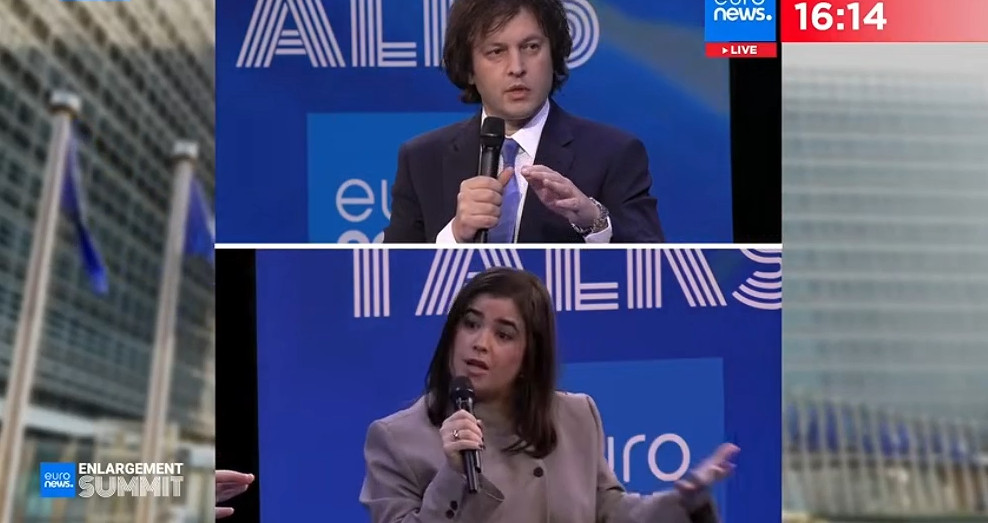
Euronews’s sit-down with Georgian Prime Minister Irakli Kobakhidze was supposed to offer scrutiny of the country’s stalled EU membership bid.
Instead, we got something more akin to a prosecutor gesturing with a microphone.
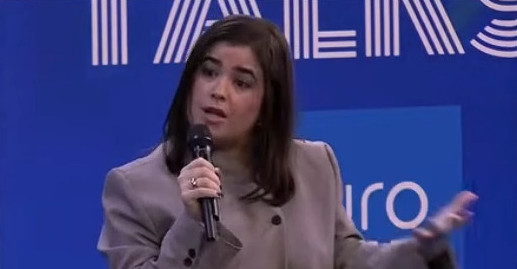
Before the November 3 live interview (LINK – segment starts at 5:00:00) even began, a presenter announced that Euronews wanted to “rough it up” for the Georgia session. Maria Tadeo certainly delivered on that.
She pointed. She waved. She squinted. She leaned forward and backward. Throughout the roughly 37-minute interview, the channel’s Europe editor addressed Kobakhidze only as “Prime Minister,” never by name. More importantly, she often asked a question and kept talking before he could answer.
At one point she asked: “You’re saying your biggest foreign policy priority is to join the European Union, correct?”
Instead of waiting for an answer, she barreled straight into a lengthy reading from the European Commission report.
After Kobakhidze cited Georgian Dream’s 2024 election victory and its 54 percent result, Tadeo promised to return to the election, but never did.
That was a significant omission. The disputed result remained central to the opposition’s case against Georgian Dream, while the government presented it as a renewed mandate. Yet neither claim was tested.
Wasn’t the entire opposition case that the election had been falsified, or are we past that now?
Other serious claims got the same treatment. Kobakhidze accused European officials of supporting the use of Molotov cocktails against Georgian police. Tadeo offered a brief aside and moved on.
It was exactly the kind of hard, down-to-earth claim that should have been tested. Which officials? What kind of support? What evidence? Viewers will never know.
Tadeo also had a habit of restating Kobakhidze’s positions in sharper terms than he used. Near the end, she summarized him as saying: “Venice Commission, I don’t care because it’s political.”
Those were her words. Kobakhidze had called the findings political while repeatedly demanding a public debate over the legal arguments.
Another of Tadeo’s shaky premises was her repeated framing of Georgia as having unilaterally halted its European path in November 2024.
The European Council had already declared the process “de facto” halted months earlier, in June. Kobakhidze presented his later announcement as a response to the EU’s move. His position was that Georgia would not place the opening of accession talks on its own agenda before the end of 2028, but would participate if Brussels decided to open them.
Tadeo’s main question was strong: Why would Georgian Dream still seek membership when it sees so many serious flaws in the EU?
At one point, she described the EU as “our club” and told Kobakhidze that Georgia was the party that had to change. The 27 members, she said, would not change to accommodate Georgia.
That answer appeared to settle the matter before any discussion could take place. The Commission had reached its conclusions. Georgia’s task was to accept them.
This central question deserved better-prepared questioning than Euronews managed to serve in its eagerness to “rough up” the Georgian leader as if it were staging a boxing match.
The problem with losing your cool is that it becomes easier for your guest to avoid hard questions.
Euronews also appeared poorly prepared on important details. One example was Tadeo’s blurring of two different laws while pressing Kobakhidze on criminal penalties.
Georgia’s 2024 transparency law relies on administrative fines. The later foreign agent legislation carries possible criminal sanctions.
That’s the kind of research Euronews’s team should have done before putting Georgia’s prime minister in the dock. All they’d need to do, is follow our reporting.