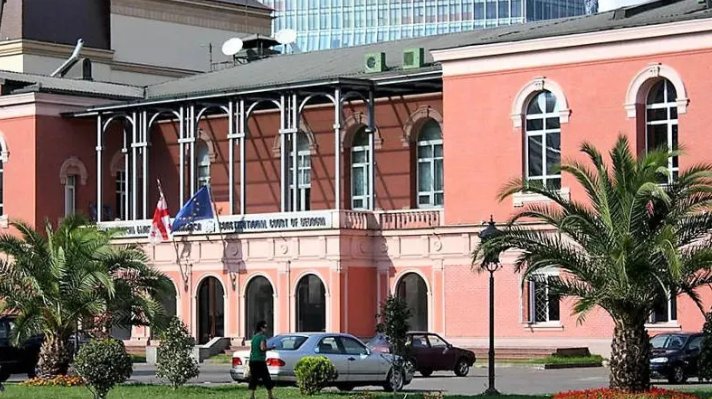
TBILISI, November 9 – Georgia’s attempt to outlaw five opposition parties has hit another snag after illness prevented one of the Constitutional Court judges from taking part in Monday’s hearing.
The proceedings, originally due to resume November 9, have been pushed back to Tuesday at noon. The court says further hearings are planned through Friday.
The delay is only for one day, but it comes after an unusual start to perhaps one of the most consequential court cases in a period of the country’s history when political differences are increasingly being settled in the courts.
In October, Constitutional Court judge Manana Kobakhidze asked to recuse herself from the party-ban proceedings. The court rejected her request. Four days later, on October 13, her tenure was terminated early at her own request, several months before her term was due to expire. The court did not say that her resignation was caused by the lawsuit.
Opposition parties have repeatedly challenged the way the proceedings are being conducted. The court rejected motions submitted by their representatives during the opening hearings, while politicians from ex-PM Giorgi Gakharia’s For Georgia party, as well as Lelo, complained that the case had been scheduled in a rush.
The lawsuit was signed by 88 Georgian Dream MPs and seeks to declare five opposition groups unconstitutional and ban them: Unity-National Movement, Coalition for Change, Strong Georgia-Lelo, the Federalist Party and For Georgia.
The case has drawn strong criticism abroad. The Venice Commission said Georgia’s rules for banning political parties are disproportionate and at odds with international standards on democracy and political pluralism. The European Union has echoed those concerns, while Council of Europe rapporteurs have warned that banning major opposition parties could seriously damage political pluralism in Georgia.
Although much of the attention has focused on the drastic measures that could result from the case, it is also the legal culmination of a much longer political process dating back more than a decade.
The United National Movement (UNM) came to power after the 2003 Rose Revolution and governed Georgia from 2004 until its election defeat in 2012. Its years in office included major state reforms, but were also increasingly marked by accusations of authoritarian rule, prison abuse, secret surveillance and political interference in the justice system.
Georgian Dream came to power in 2012 campaigning on a promise to “restore justice”. The pledge followed years of protests and demands to investigate abuses committed under the previous government and compensate victims. After taking office, the new authorities prosecuted a number of former officials, while at the same time discussing forms of reconciliation and amnesty for some lower-ranking officials.
The broader reckoning, however, remained unfinished. In 2015, DFWatch reported that Georgian Dream was only then reviving its 2012 “restore justice” promise in relation to property confiscations, after creating a special unit in the Prosecutor General’s Office to examine past abuses.
More than a decade after the change of power, Georgian Dream launched the parliamentary investigation headed by Tea Tsulukiani. Initially focused on alleged abuses under the UNM government, its mandate was later expanded to cover political developments after Georgian Dream itself came to power in 2012. Critics argued that the widening scope turned the commission into a tool against current political rivals, while Georgian Dream maintained that it was documenting unresolved wrongdoing.
After summer of 2025, there were signs that the commission’s findings could lead to attempts to outlaw opposition parties. Its final report accused the former UNM government of systematic abuses, including torture, unlawful imprisonment, secret surveillance and corruption, while also examining more recent political events. The opposition dismissed the commission as a political weapon.
Georgian Dream argues that the five parties now before the Constitutional Court have engaged in unconstitutional activity and says the hearings will expose their conduct further.
The opposition rejects the case as an attempt to eliminate political competition. Lelo representative Giorgi Sioridze says his party plans to attack Georgian Dream’s arguments point by point, while UNM representative Lasha Parulava says the outcome has already been politically decided.
The court has now completed the stage in which the sides presented their explanations and arguments. When hearings resume Tuesday, judges are expected to begin questioning both sides.