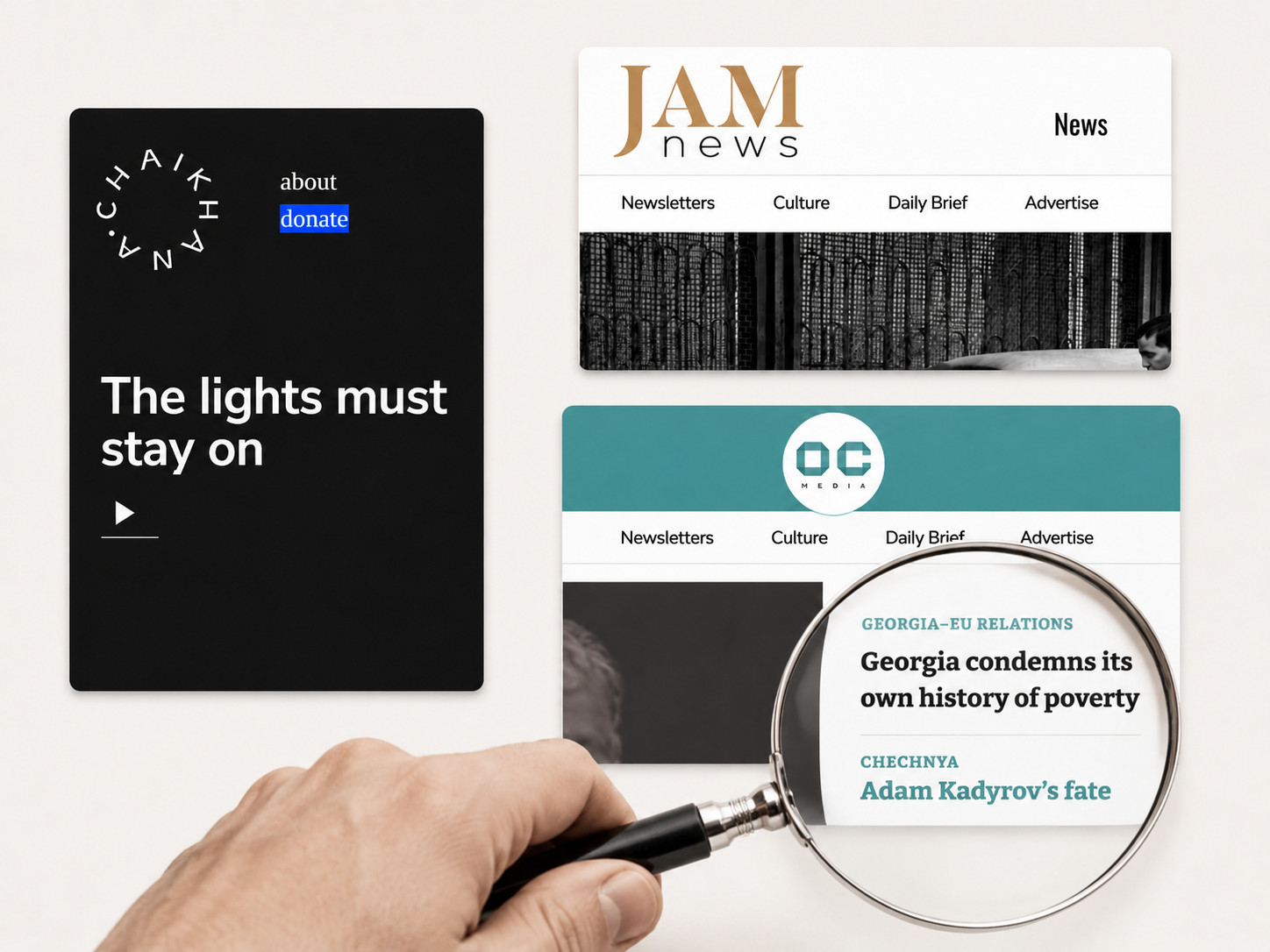
Here are 8 tell-tale signs that the Georgia “news” site you are reading is not independent.
Georgia has many outlets that describe themselves as independent media. Some do real reporting. Others function more like influence platforms: selecting facts, amplifying friendly NGOs, laundering embassy positions, and presenting political narratives as neutral truth.
Walter Lippmann warned that people often respond not to reality itself, but to the picture of reality placed before them. In Georgia, that picture is often produced inside a donor-funded political framework. Here are eight signs that a Georgia “news” site may be managing your perception rather than informing you.
Every story has a political message
The first tell-tale sign is pretty straightforward: Do they ever report news that doesn’t have a political subtext? If the site never reports ordinary news that can’t be spun, like accidents, trade figures, public health problems, mundane criminal cases, infrastructure, weather, local events, but only stories that point toward one political conclusion, it is probably not a news site. It is an influence machine.
Good news that complicates the narrative disappears
If the government is investigating officers accused of violence against journalist Guram Rogava, that is news. It does not erase wider concerns about police violence, but it should still be reported. If a site only covers facts that hurt Georgian Dream and ignores facts that complicate the story, it is not informing readers. It is managing perception.
NGOs are treated as neutral judges, never as political actors
A real news site can quote watchdog groups. But if NGOs are always presented as objective truth-tellers, while their funding, networks, political incentives and mistakes are never examined, the reader is not getting journalism. The reader is getting a curated ecosystem.
Western embassies are treated as moral authorities, not political institutions
Embassies represent states. States have interests. Treating a foreign state’s self-proclaimed benevolence as fact is naïve. Most recently, we saw how a German ambassador and the EU’s ambassador avoided addressing the internal human rights problems inside the bloc, while criticizing Georgian authorities for the same. Foreign states may defend democratic principles, but they are not above politics. If a Georgian outlet treats embassy statements like absolute truth, while treating Georgian officials as guilty by default, it may mean you are being manipulated.
Labels replace evidence
When us/them type terms like “pro-Russian,” “authoritarian,” and “regime” are used to prop up an argument, your critical senses should sharpen. Words like “pro-Russian” may sometimes be relevant, but there’s a particular way of using them that should stir your suspicion. If they appear as labels instead of arguments, they are doing the work that evidence should do. A reader should ask: did the article prove the claim, or just repeat the label?
Election claims are treated as settled fact when they are still contested
The 2024 election had serious problems: pressure, intimidation, voter tracking and compromised secrecy. But that is not the same as proving the result was fabricated, as one Tbilisi-based academic claimed after that election. If a site slides from “irregularities” to “stolen election” without showing the evidence, it is shaping perception rather than reporting.
The site never corrects the direction of its own narrative
Real journalism adjusts when new facts appear. Influence work does not. In some court cases after the post-election unrest, judges sided with defendants against the prosecution. Yet many Georgia-focused information sites followed the opposition’s lead in treating even those rulings as further proof that the courts were politicized. If the same storyline survives every new development, police prosecutions, court decisions, economic data, diplomatic nuance, then the conclusion was probably chosen before the reporting began.
Human stories are turned into political proof
Some photo-heavy outlets are especially good at this. Poverty, migration and suffering are presented with real skill and emotional force, but the human story often becomes material for a pre-selected political message. Serious journalism lets human lives remain messy. Influence journalism uses hardship as evidence for a conclusion chosen in advance.
The opposite of influence work is the old journalistic discipline of following the facts even when they lead somewhere inconvenient. The point is not to ask whether a fact helps “our side” or “their side”. The point is to report the picture the facts actually show.
Which is what we try to do here at DFWatch, and we could use your help.