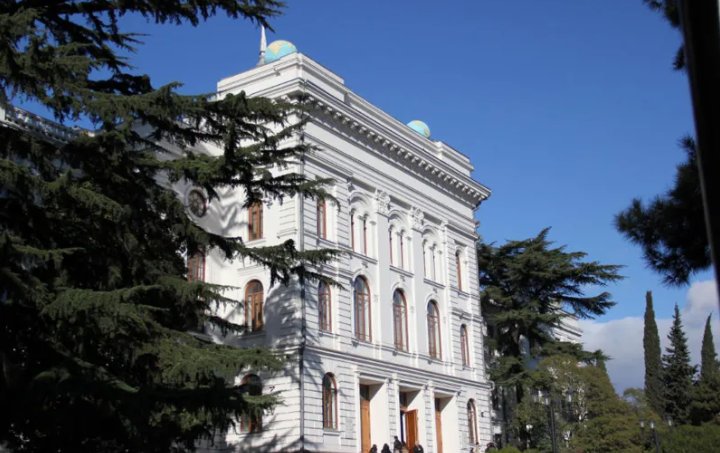
TBILISI, February 3 – Students rallied on Monday after the government announced plans to merge two universities, a move that triggered a vigorous debate.
There were protests at the first building of Ivane Javakhishvili Tbilisi State University (TSU), where students opposing the proposed merger with the Georgian Technical University (GTU) demanded to attend a meeting of TSU’s Academic Council. University security did not let them inside, citing safety measures, according to Georgian media reports.
Students said TSU rector Jaba Samushia had previously promised that a group of students would be allowed to attend the council session. Instead, they found the doors closed and asked the rector to meet them publicly.
Later, one TSU student told reporters that six students met Samushia and pushed for a broader meeting. The student said the rector told them he did not yet have a final position and was waiting to hear views from faculties, councils and deans. The student also said Samushia signaled he would meet students again after speaking with the education minister, but rejected allowing media into that meeting, while students would be able to stream it themselves.
The government’s plan, as reported by Interpressnews, is to unite TSU and GTU under one structure. The cabinet decision would be followed by a ministerial order creating a temporary governing body, and appointing acting leadership to run a reorganization process.
Government figures have tried to sell the idea as a win for students and a boost for Georgia’s global standing. Parliament vice-speaker Nino Tsilosani argued students would be the biggest beneficiaries because they would graduate with diplomas carrying the TSU name.
Mariam Lashkhi, who chairs parliament’s education committee, called it “disinformation” to say any university is being shut down. She said the goal is to pool resources and plan programs more rationally, referencing a broader reform slogan described as “one faculty, one city.” Lashkhi said the aim is to raise education quality so a Georgian university can reach the world’s top 500 and eventually top 200.
Another senior lawmaker, David Matikashvili, said the reform is meant to lift standards and improve pay, so young Georgians do not feel they need to leave the country for education.
But resistance has come fast, including from inside TSU. A group of professors from TSU’s Faculty of Social and Political Sciences published an open letter saying none of the 62 professors who took part in an internal survey agreed with the merger idea. They urged decision-makers to pause any fundamental changes to the university’s status and structure and to start broad, public consultations with the academic community.
At GTU, professor Nato Katamadze publicly pushed back on Tsilosani’s comments about students being “happier” to receive TSU-branded diplomas. Katamadze said Tsilosani completed a doctorate at GTU in 2020 and questioned why she studied there if the institution was supposedly something to be embarrassed about. Katamadze also argued that decisions made without the academic community are “always doomed,” and claimed even GTU’s rector learned about the decision from television.
Opposition politician Khatia Dekanoidze, one of the leaders of the United National Movement, went further, calling the merger a de facto cancellation. She claimed, citing her own information, that 60 to 70 percent of GTU staff could be fired and that student intake could be reduced. She also alleged the real goal is to sell off buildings.
Meanwhile, the Education Ministry has started meeting university representatives. Deputy minister Zviad Gabisonia met the GTU rector and around 70 professors on Monday in a session that, the ministry said, lasted more than four hours. A similar meeting with TSU representatives was scheduled for 5pm on Tuesday, with the merger as the main topic.
TSU said its governing bodies, including the Academic Council and Senate, held a joint session and agreed that talks with the ministry were appropriate given the issue’s importance. TSU also said Samushia met students after that session and stressed the need to keep dialogue going in the academic space.