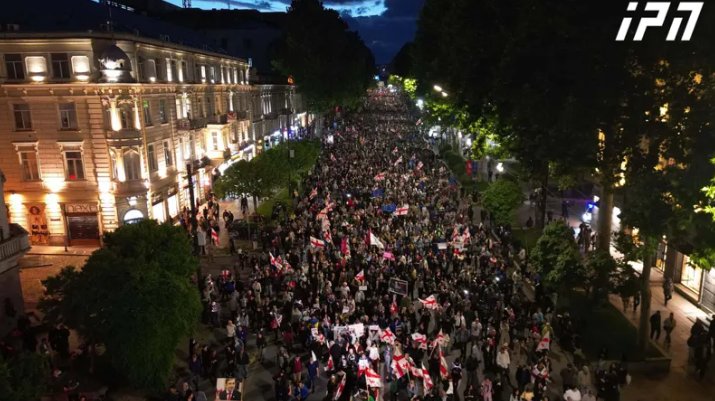
Georgia’s Independence Day saw two celebrations: the government’s and the opposition’s.
But in Western media, and among Georgia’s own duck pond of grant-run outlets, the opposition’s evening event took center stage and was largely presented as a pro-European democracy rally.
Euronews led with “thousands of protesters” marching through Tbilisi for a “pro-Europe rally.” JAMnews called it “the largest protest seen in recent months” and said the opposition launched a campaign under the slogan: “Georgia deserves better.”
One important omission is that in most European countries, an opposition attempt to set up a stage and sound system in front of parliament on the national holiday to call for the ouster of “the regime” would not be treated as a normal democratic celebration. It would be seen as a provocation on the state’s most symbolic day of unity, when differences are usually downplayed and shared identity emphasized.
The government spoke of the need for unity in the country. That theme was also mentioed by the opposition figure Giorgi Vashadze,who urged the crowd to build trust in society as a way forward. But the form of that action was confrontational.
It’s not new, of course. In Georgia, May 26 has been used by opposition forces for many years as a day to rebel against “the regime”. The same pattern existed under the previous UNM government. The roles have changed, but the ritual remains.
What was missing from the media coverage was, first of all, that the rally was not really a breakthrough. As DFWatch reported, analysts described it as falling short of broad public mobilization. One called it “a rally for the sake of a rally.”
Second, the government’s sovereignty message was treated as empty propaganda, when it is key to understanding Georgian politics.
Georgian Dream’s rhetoric about the “deep state” and decadent Europe is crude, but the message of standing up to pressure from Brussels has real appeal among part of the population.
Western audiences are repeatedly misled on this point. If they do not understand why the sovereignty message works, they are more easily persuaded by the opposition’s claim that the 2024 election was outright falsified.
Many voters who respond to the sovereignty message have grown disillusioned after waiting more than 20 years for the Western reform promise to bring prosperity, dignity and stability. For some, that promise now sounds hollow, while the message of relying on homegrown ideas and returning to the country’s roots has more appeal.
That doesn’t mean those are somehow against Europe, a geographical and cultural area. Presenting yesterday evening’s anti-GD rally as simply pro-European is a gross distortion that misleads audiences around the world and obstructs their understanding of Georgia’s deep political and cultural divide.