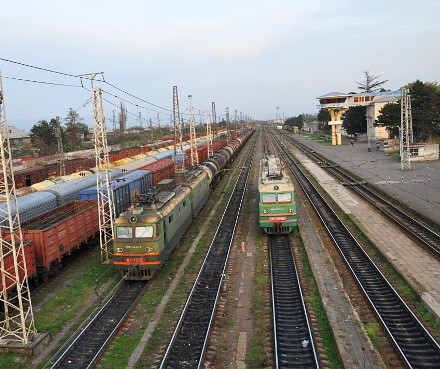
TBILISI, March 10 – Georgia’s domestic rail freight has fallen sharply over the past decade, with transport experts blaming neglected branch lines, very low speeds and a system that can no longer compete with road haulage.
Speaking on Palitra News, Paata Tsagareishvili, head of the Transport Corridor Research Center (TCRC), said local cargo shipments on Georgian Railway have dropped threefold compared with 2011. He said one major reason is infrastructure that has fallen into poor condition, especially on branch lines where train speeds have been cut and customers no longer see rail as attractive.
Tsagareishvili said Georgian Railway has around 10 branch lines, but the condition of the tracks on a number of them is, in his words, “truly dire.” With speeds low on those lines, he said, road transport is moving to the front. He also argued that the growing use of trailers for cargo creates environmental problems and damages road surfaces, especially when trucks carry heavy loads such as inert materials from quarries.
He added that rail is in a weak competitive position because its tariff policy is regulated, while overloading on the road side can give truck operators an edge. At the same time, he said there are broader systemic problems, including a long delayed need to modernize equipment. Still, he pointed to one positive sign: what he described as a “new breeze” in rolling stock renewal, especially in locomotive power.
Another TCRC expert, Levan Lomsadze, said road transport sometimes uses loads above the permitted limit, which in his view gives it an “unfair advantage” over rail while also damaging road infrastructure. He said some Georgian rail branches are effectively unusable, and pointed to very low permitted speeds, in some cases 15 kilometers per hour, as a key reason rail cannot compete with trucks.
Lomsadze highlighted several neglected lines. He said the Borjomi-Bakuriani narrow-gauge railway has not functioned since 2020, though there is information that rehabilitation is planned. He also said passenger rail service toward Kakheti remains out of operation. By contrast, he noted that Armenia had preserved rail infrastructure leading to its borders even when it was not functioning, instead of dismantling it.
Both experts argued that fixing the network should not be left to Georgian Railway alone. Lomsadze said the state needs a strategy for maintaining and rehabilitating these lines, just as it directly finances roads as a public good. He also said rail infrastructure should remain in state hands and made clear he does not support privatizing it.