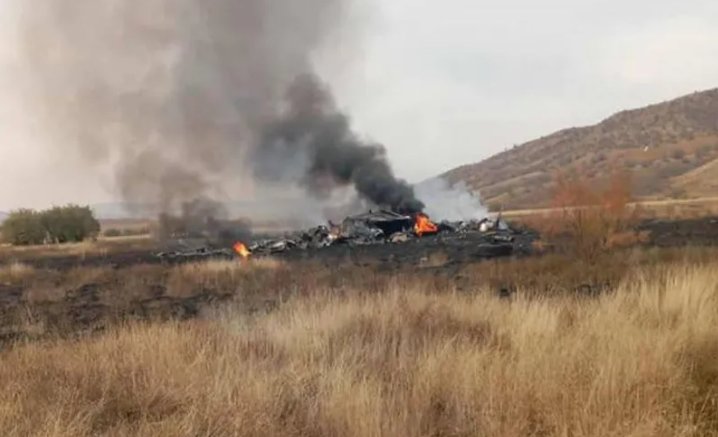
TBILISI, November 12 – Preliminary findings after a Turkish Air Force C-130 military plane crashed in eastern Georgia on Tuesday indicated that the disaster may have been caused by a technical malfunction.
Georgia’s Interior Minister Geka Geladze confirmed Wednesday that 18 bodies have been recovered from the crash site, while search teams continue to look for two others still missing. An international investigative team has been formed, which also includes Turkish experts.
According to reports from Azerbaijan’s APA news agency, which cited informed sources, the aircraft carried spare parts for F-16 fighter jets and personnel providing technical support for Turkey’s air fleet. The same team had been in Baku for the military parade held on November 8.
APA said the cargo plane, which had been in service for many years, last underwent major maintenance in 2020. The report added that all crew and technicians aboard went through standard security checks at Ganja Airport before takeoff, a process documented by surveillance cameras.
Initial visual inspections reportedly show no signs of external impact on the aircraft’s fuselage. Investigators explained that damage patterns such as holes or burn marks would normally be expected if the aircraft had been struck by a missile or experienced an onboard explosion.
Technical findings indicating explosive damage were found after last year’s crash of an Azerbaijani Embraer-190, where multiple holes supported a theory of external impact, and consequently, that the aircraft had been shot down. No such evidence has been found in the Turkish C-130 wreckage so far.
Experts quoted by APA say two main possibilities are being considered. The first is that long-term corrosion may have weakened the aircraft’s structure, making it vulnerable to pressure differences at cruising altitude. The second involves the possibility of cargo shifting inside the fuselage if it was not properly secured, potentially causing a sudden imbalance during flight.
The report emphasized that rumors circulating on social media about a possible attack or sabotage were unfounded. “There is no evidence supporting such claims,” the source told APA, adding that the aircraft’s black box will clarify the exact cause of the crash once recovered and analyzed.
The C-130 Hercules, a four-engine military transport aircraft, went down on November 11 in Georgia’s Sighnaghi district, about five kilometers from the Azerbaijani border. The plane was flying from Azerbaijan to Turkey when it disappeared from radar.
Georgia’s Interior Ministry said it has opened a criminal investigation under Article 275, Part 4 of the country’s criminal code, which covers violations of air transport safety rules leading to loss of life. Georgian and Turkish officials are conducting the investigation jointly, with Azerbaijan providing technical assistance.
Search and recovery operations are continuing near the crash site in a mountain region where bad weather and rugged terrain have made access difficult. The Turkish Ministry of Defense has not yet released an official statement on the number of people killed.
Both Georgian and Turkish leaders offered their condolences. Prime Minister Irakli Kobakhidze spoke by phone with President Recep Tayyip Erdoğan late Tuesday, expressing solidarity and promising full cooperation in the investigation.