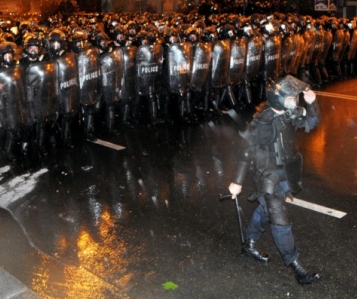
TBILISI, May 26 – A Georgian politician has revived one of the darkest cases from the violent May 26, 2011 protest dispersal in Tbilisi, claiming that one of the dead showed signs of torture after the crackdown.
David Lortkipanidze spoke to the program “Anatomy of the Regime” about Suliko Asatiani, who died after the police operation against anti-government protesters near parliament 15 years ago.
According to Rezonansi, Lortkipanidze said he personally saw injuries on Asatiani’s body after it was brought down for viewing.
He claimed Asatiani’s throat was torn, his left eye was pulled out, and his arms were bruised. Lortkipanidze said the injuries suggested Asatiani had been suspended and tortured. He also claimed that green antiseptic had been applied because Asatiani may still have had signs of life at the time.
Lortkipanidze also claimed that after Asatiani’s body was brought home, a video camera was installed to record everyone who came to pay respects. He said people were later intimidated so they would not attend the funeral.
He further said the family had asked for an independent examination, and that expert Aleksandre Gejadze took biological samples after the body was transferred to a morgue in Kutaisi. But Lortkipanidze claimed the state forensic material needed for comparison had already been destroyed.
The May 26, 2011 dispersal remains one of the most controversial episodes of Mikheil Saakashvili’s presidency. An opposition movement led by former parliament speaker Nino Burjanadze had gathered near parliament on May 25, refusing to move before the planned Independence Day parade. Shortly after midnight, police moved in to clear Rustaveli Avenue and the area in front of parliament. Several people died, and human rights groups later criticized the operation.
DFWatch reported at the time that President Saakashvili defended the police action, saying it was necessary and describing the use of force as minimal. He argued that the protest was led by provocateurs financed from abroad and that the government had acted correctly.
After Georgian Dream came to power in 2012, former Interior Minister Vano Merabishvili was prosecuted over the May 26 dispersal. In 2014, Tbilisi City Court found him guilty of abuse of power and sentenced him to four years and six months in prison. The Appeals Court later upheld the verdict. Merabishvili denied the charges.
In 2016, prosecutors also charged four former officials over the same operation, alleging that police had blocked escape routes, carried out mass arrests and used physical and verbal abuse against demonstrators. Prosecutors said the operation was aimed not simply at dispersing the rally, but at punishing protesters.