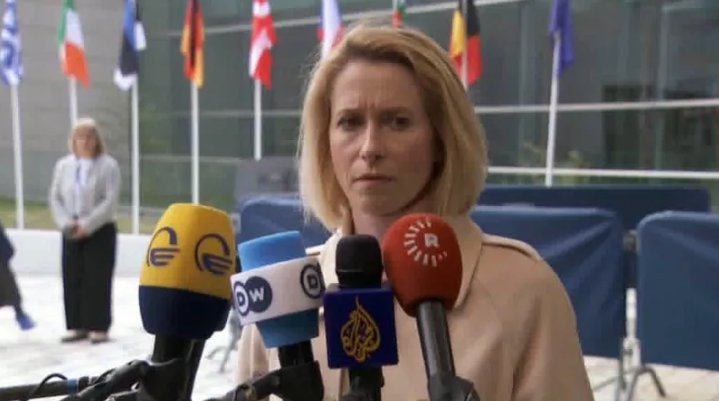
TBILISI, April 23 – Threats of sanctions from Kaja Kallas on Monday triggered a sharp rebuke from Tbilisi, with one parliamentarian accusing the EU foreign policy chief of ‘trampling on the basic democratic principle that people choose their government.’
Commenting ahead of a meeting of EU foreign ministers in Luxembourg on Monday, Kallas stated that the bloc supports “the Georgian people, but not the Georgian government,” which she said is moving in “the wrong direction,” Interpressnews reported.
She added that the Georgian government’s course of repression against the opposition, media restrictions and adopted laws, is unacceptable to the EU.
The comments exposed how deep the divide between Brussels and Tbilisi has become. The bloc halted membership negotiations nearly two years ago because of a ‘foreign agents‘ law and other measures imposing restrictions on civil society and media that Tbilisi claims are necessary to stem foreign meddling but the opposition say move the country toward a ‘Russian’ style authoritarian system.
Kallas said Georgia was showing no signs of reversing the ‘democratic backsliding.’ She added that EU ministers had a clear message that “Georgia must change course,” and said there was broad support among member states for possible sanctions against those responsible for actions against “free media” and the opposition, even though one country was still blocking such a step.
The sanctions threat was met with angry reactions from the Georgian leadership. Foreign Minister Maka Botchorishvili rejected the demand for a policy shift and said, “Georgia has nothing to change.” She argued that the country’s course is aimed at protecting national interests, peace, stability and economic development, and said that if anyone needs to change its attitude, it is “the current EU bureaucracy in Brussels.” Earlier, she had also accused Kallas of trying to define whether Georgia is isolated and said, “Kaja Kallas cannot determine whether Georgia is in isolation.”
Archil Gorduladze, a member of parliament for GD, went further and said Kallas was trampling on the basic democratic principle that people choose their government, and declared, “if she imagines that someone should be appointed from outside with ‘ruler’ written on the door, this will not work.” Tbilisi Mayor Kakha Kaladze, meanwhile, dismissed the sanctions talk and said European bureaucrats do not like arguments, but rely only on “superficial messages, threats and blackmail.”
The United States has imposed visa restrictions on Georgian officials and others accused of undermining democracy, while the European Union has suspended visa-free travel for Georgian diplomats and officials and has discussed possible targeted sanctions.
Some leaders within the bloc have tried to rally members states to pass a blanket suspension of visa-free travel for all Georgian citizens into the Schengen Area, but such a measure has not succeeded.
EU Ambassador to Georgia, Pāwel Herczyński, said in June 2025 that the majority of member states oppose the measure, warning it would unfairly target everyday Georgians.