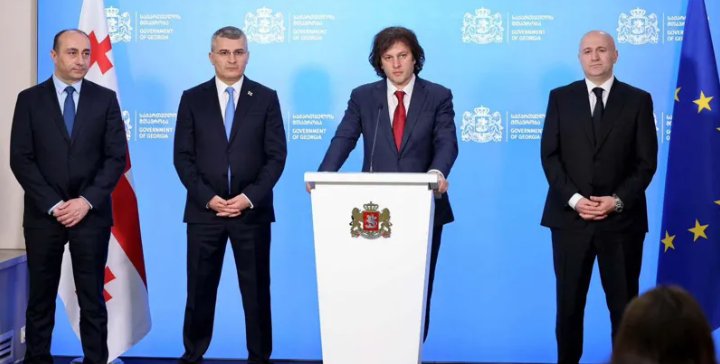
TBILISI, April 22 – Georgia has appointed Sulkhan Tamazashvili as minister of internal affairs in a wider government reshuffle that also changes the chain of command around the country’s security institutions.
Prime Minister Irakli Kobakhidze announced the move at a press conference in the government administration on Tuesday, April 21. Tamazashvili had been serving as chairman of the government of Adjara, Georgia’s autonomous region on the Black Sea. Kobakhidze said a candidate to replace him in Adjara would be named in the coming days after consultations with the president of Georgia and the Supreme Council of Adjara.
“The position of Minister of Internal Affairs of Georgia will be held by Sulkhan Tamazashvili,” Kobakhidze said, thanking him for what he described as successful work in Adjara and adding that he is “a veteran representative of this system” who is well known inside the interior ministry structure.
The change is part of a broader reshuffle. Kobakhidze also said the government structure would gain a new post, state minister for coordination of law enforcement agencies, to be held by Mamuka Mdinaradze, who will also serve as deputy prime minister. At the same time, parliament is to be presented with Geka Geladze as candidate to head the State Security Service.
Government supporters cast the changes as a strengthening of the state. First Deputy Speaker Nino Tsilosani called the reshuffle “a strong relocation” that would further reinforce state institutions. Archil Gorduladze, chair of parliament’s legal affairs committee, said the cabinet would soon send the required legislative changes to parliament so the new ministerial post can be formally created.
Opposition figures described the moves as a political ‘carousel’ inside the ruling power circles. The Opposition Alliance said the government reshuffle was “another confirmation of the legitimacy crisis of Ivanishvili’s regime.” Former president Salome Zourabichvili mocked the reshuffle as “a completely ritual rotation,” while opposition politicians including Nika Gvaramia and Levan Gogichaishvili portrayed it as confusion and demotion inside the ruling camp.