Sometimes, apples and pears can be compared. At least, that’s what we’re led to believe by the esteemed editors at JAM News.
JAMnews invokes Georgia’s 2012 prison scandal in its coverage of Giorgi Davitadze’s sexual-abuse allegation. It supplies the historical horror, but leaves out much of the historical change. Georgian Dream came to power on a mandate from voters to clean up the prison system, and the incoming government undertook reforms whose results the UN subsequently recognised.
Davitadze has made a serious allegation. He says he was sexually abused by a number of prison staff the night of December 20-21, 2025, in a room called a ‘de-escalation cell’, used to restrain an unruly prisoner.
If true, the allegation should have consequences. Mistreatment of a prisoner should be taken extremely serious, especially on the background of earlier systemic problems in Georgia. The truth of the allegation must be established.
Now, let’s look at what JAM News is comparing the case with. The pre-2012 situation was an extensively documented crisis stretching over years.
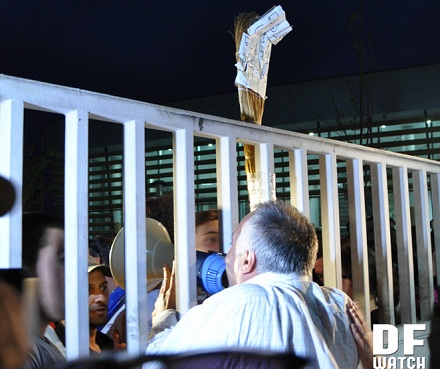
We know, because we were reporting on it back then. Prisoners and families repeatedly described abuse. The Public Defender issued warnings. DFWatch recorded suspicious deaths, named officials accused of mistreatment and a petition signed by 693 prisoners months before the videos appeared. There was an ongoing crisis of mistreatment that touched many families. The videos, released two weeks before the parliamentary election, were the trigger. And it released an emotional wave – the ‘Broomstick Revolution‘ because of a video showing a prisoner raped with a broomstick while guards taunting him – which swept Georgian Dream to power.
Contemporary accounts describe overcrowded barracks and degrading conditions. After Georgian Dream took power, some institutions were closed permanently; others, including Ksani’s tuberculosis prison, were closed, reconstructed and reopened. This was part of the response to voters’ demand for a clean-up. Invoking 2012 without explaining the reforms that followed gives readers only half the history.
Let’s look at the UN’s assessment. In 2015, its Special Rapporteur recognised substantial improvements following the reforms. His report recorded prosecutors’ account of approximately 8,000 complaints concerning torture and ill-treatment before the October 2012 election. That gives some perspective on the historical problem.
If we look more recently, the UN’s 2023 delegation received no allegations of torture or ill-treatment by prison staff. The Council of Europe’s 2024–25 inspection received no allegations of physical staff abuse either.
These inspections describe a substantially different situation from the documented crisis before 2012. Davitadze’s allegation does not establish a return to that earlier pattern of prison-staff abuse. JAMnews’s historical framing runs ahead of the evidence.
That said, the reports show that serious failures remain, including intimidation, prisoner hierarchies and prolonged isolation. Such findings do not give grounds for making a false equivalence to 2012, but they do merit efforts to push for further reforms.
Funding pressures belong in any examination of a grant funded platform’s output. We have felt the same pressures. The next grant application requires a compelling problem and an organisation needed to address it. Problems becomes the organization’s raison d’etre. The problem is that this rewards the amplification of crisis while improvements receive less attention. Advocacy organisations should be scrutinised for those incentives as readily as commercial media are scrutinised for theirs.
JAMnews also moves between prison conditions and reports concerning policing, arrests and protests. Those distinctions matter. Evidence of police abuse cannot automatically establish a trend of abuse by prison staff. Citing Amnesty does not remove the obligation to explain exactly what its evidence demonstrates.
Investigate Davitadze’s allegation. Establish what happened and hold anyone responsible to account. But invoking 2012 while failing to explain the transformation that followed gives readers a distorted history.
One prisoner’s allegation deserves better than being exploited to serve a partisan narrative.