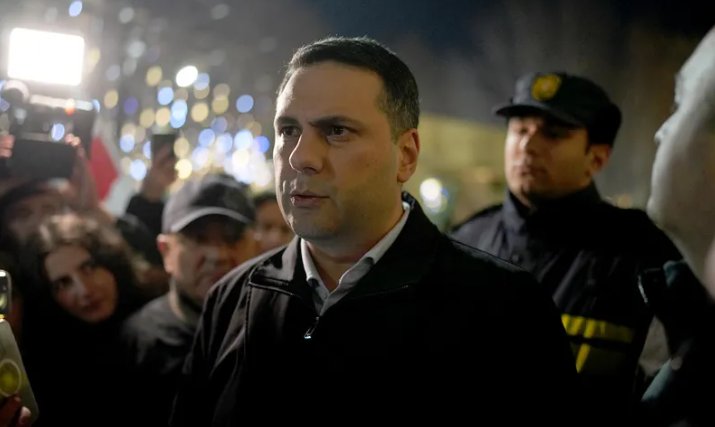
TBILISI, December 18 – Protests resumed Wednesday evening on Rustaveli Avenue in central Tbilisi, despite verbal warnings by police the day before to adhere to new, stricter rules for public assemblies.
The rally marked the 385th consecutive day of protest near parliament, with demonstrators again demanding new parliamentary elections and the release of people detained during earlier protests. Police asked protesters standing on the sidewalk to clear pedestrian space, after which demonstrators briefly positioned themselves in front of a police vehicle. Patrol units later withdrew from the immediate area.
The renewed protest followed a late-night visit on Tuesday by Patrol Police Department Director Levan Maisuradze, who personally warned demonstrators that recent amendments to the law on assemblies and manifestations would be enforced with the full force of the law. He told protesters that gatherings held in pedestrian areas now require prior notification to the Interior Ministry at least five days in advance. Failure to comply, he said, could result in administrative detention of up to 15 days for participants and up to 20 days for organizers.
The amendments, approved by parliament last week, expand the notification requirement to protests that obstruct pedestrian movement. They also give the Interior Ministry authority to suggest changes to a protest’s location or route if it considers the gathering a risk to public order or transport. Repeated violations can lead to criminal liability, including prison sentences of up to one year.
Georgia’s Public Defender Levan Ioseliani raised concerns about how the new rules may be applied in practice. In a statement issued Wednesday, the watchdog warned that the broadly worded provisions risk allowing disproportionate interference with the right to peaceful assembly, particularly when protests cause only limited and temporary inconvenience to pedestrians.
The Public Defender stressed that notification requirements must not function as a hidden permit system, which is prohibited under Georgia’s constitution, and pointed to European human rights standards stating that failure to notify authorities should not automatically make a protest unlawful.