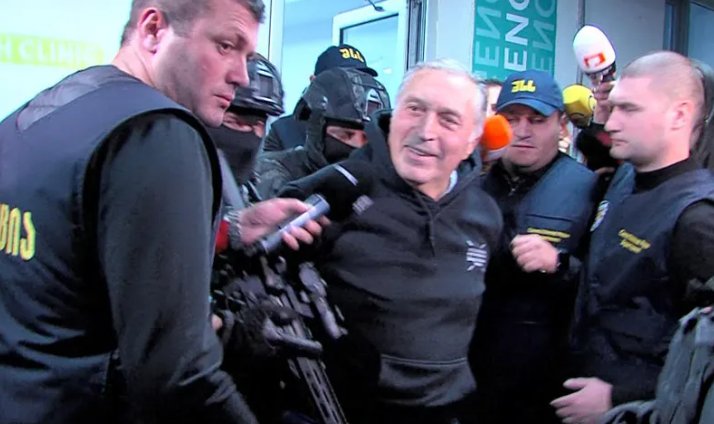
TBILISI, October 7 – Famed Georgian opera singer turned activist Paata Burchuladze, one of the main figures detained over the failed October 4 “peaceful revolution,” told a Tbilisi court Tuesday that he was trying to prevent violence, not incite it.
Burchuladze, founder of the “Rustaveli Avenue” movement, said that during the unrest near the presidential residence, he and his colleague Murtaz Zodelava were working to calm tensions between protesters and riot police.
“I saw that the fence was broken, so I climbed over and went to the ‘Robocops,’” he told the court, using a popular nickname for Georgia’s armored police units. “I was stopping people from both sides so that no clashes would happen. And they call this an attempt to incite violence?”
The 68-year-old charity founder, long celebrated for his humanitarian work and opera singer career, described how he was hit multiple times with pepper spray before collapsing and being hospitalized. “They came at me with automatic weapons,” he said. “If they see a terrorist in me, I’m ready to be punished, but even if not, I’m still ready to be punished.”
Burchuladze, Zodelava, and opposition politicians Irakli Nadiradze, Paata Manjgaladze, and Lasha Beridze were arrested after violent clashes broke out during an anti-government protest that organizers had promoted as a “peaceful revolution.”
Prosecutors have charged the five under several articles of Georgia’s criminal code, including organizing group violence, attempting to seize strategic state facilities, and inciting the violent overthrow of the constitutional order. The charges carry prison sentences of up to nine years.
In court, Burchuladze rejected the government’s portrayal of him as a threat to national security. “They want to show that there are terrorists sitting here,” he said. “But I’ve spent my life helping children. Do you really believe I would call on anyone to stab or kill?”
He also defended the October 4 gathering as a historic civic moment. “For the first time in Georgia’s history, citizens came together from across the country because we felt the nation was in danger,” he said. “Historians will one day remember this as a day of unity, not of violence.”