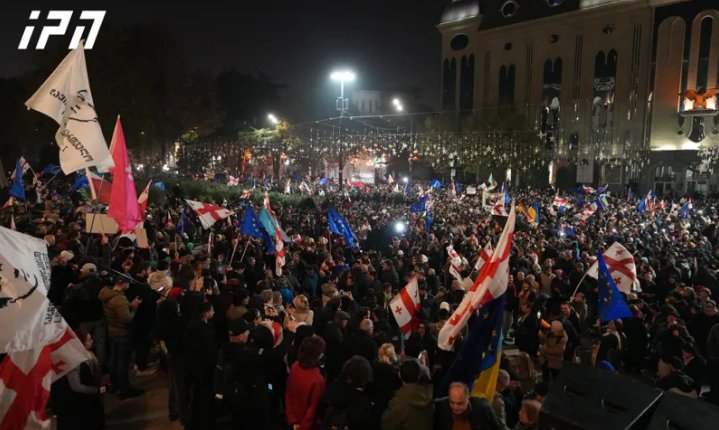
TBILISI, May 25 – Georgia’s government is again talking about possible pardons for people detained during anti-government protests. But its condition has not changed: prisoners must admit guilt and show remorse first.
Prime Minister Irakli Kobakhidze said Monday that the government had already made its position public and had also shared it several times with the Georgian Orthodox Church.
“Where there is admission and remorse, appropriate steps will be taken,” Kobakhidze said at a press conference. He added that this position is “very firm and clear.”
Asked whether remorse is legally required for a pardon, Kobakhidze said it is not.
“Legally, no, this is needed for crime prevention. This is needed for the state,” he said.
The issue has returned to the center of politics as Georgia’s long-running protest movement prepares for a major May 26 rally in Tbilisi. Protesters and opposition groups are demanding the release of people they describe as political prisoners, along with new elections and a return to the country’s European path.
Many of the detained protesters reject the government’s demand for remorse. They say they do not admit guilt and view the demand as unfair. Their relatives and protest supporters argue that the condition looks more like a political requirement than a humanitarian gesture.
The Georgian Orthodox Church is also involved in talks. Father Andria Jagmaidze, head of the Patriarchate’s public relations service, said dialogue with the authorities on the release of prisoners has not ended.
“We are talking, we are looking for a way out,” Jagmaidze told TV Pirveli. He said the Patriarchate has no mechanism to issue ultimatums to the state.
Analysts quoted by Rezonansi disagree over why the issue has become active again now.
Giorgi Abashidze, a government-leaning analyst, said the state has its own interests, while the Patriarchate has a humanitarian agenda. He argued that if a prisoner remains highly politicized, refuses to recognize the government and does not regret a serious crime, it is hard to discuss a pardon.
He also said the opposition should stop saying Georgian Dream is illegitimate if it wants reconciliation and bridges to be restored.
Abashidze stressed that the final decision belongs to President Mikheil Kavelashvili, who has the constitutional power to pardon individuals or groups.
Paata Zakareishvili, a conflict expert and former state minister, said the timing may be linked to the presence of a high-level U.S. delegation in Georgia. In his view, Western partners are likely pressing the government over the detainees, but Georgian Dream does not want to create the impression that foreign visitors can simply arrive and force releases.
Zakareishvili said a pardon would probably not anger Georgian Dream supporters, but the government does not want the opposition to present it as a victory.
He also said the issue could become a test for the new Patriarch, Shio III. If the Patriarch openly asks the authorities to release the prisoners, Zakareishvili said, the government would either have to listen or refuse.