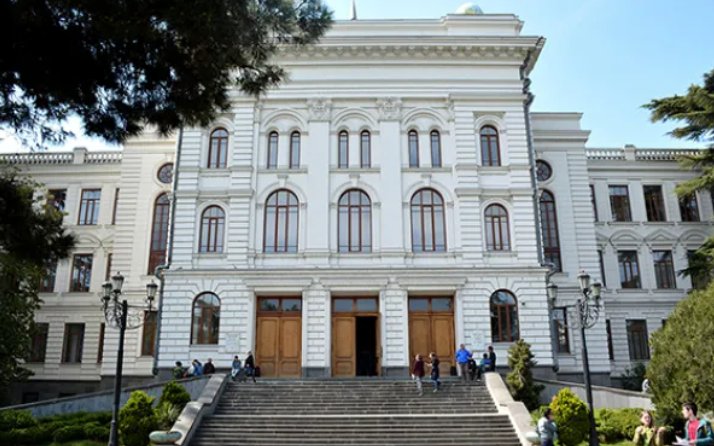
TBILISI, December 6 – Georgia’s government is preparing an overhaul of higher education financing, where university students will be faced with state and private institutions as two separate tracks and the public option will be free.
Starting from the 2026 to 2027 academic year, studies at public universities will become free for students. Instead of financing individual students through grants, the state will send money directly to public universities. At the same time, students who enroll in private universities will no longer receive state grants, ending a long-running system where applicants could take their exam-based scholarships to any accredited university.
Today’s system allows students to use their national exam results to secure state grants that can then be carried to public or private universities. The maximum bachelor-level grant is 2250 lari, equal to full tuition coverage under the current cap. Smaller 70 percent and 50 percent grants are also available. All of this will disappear for private university students under the new rules.
The change comes after a year in which Georgia’s grant program supported thousands of new students. In 2025, a total of 31,705 freshmen entered universities across the country. Out of these, 7,320 students received grants, equal to 33.7 percent of all new entrants. Of those awarded grants, 1,785 received the full amount, 1,457 received 70 percent grants, and 4,075 received 50 percent grants. The total grant fund for 2025 amounted to 11 million lari.
Most grant recipients ended up in public universities. In 2025, 4,734 students with grants enrolled in public institutions, absorbing 7.19 million lari of state money, or about 66 percent of the year’s entire grant fund. Private universities received the remaining 34 percent, with 2,584 grant-backed freshmen sharing 3.7 million lari.
Among public universities, Tbilisi State University enrolled the highest number of grant students, with 2,325 first-year students sharing 3.5 million lari in funding. Ilia State University followed with 675 students and just over 819,000 lari, while the Technical University ranked third with 468 students and roughly 718,000 lari.
On the private side, Tbilisi’s Free University received the largest total amount of grant funding this year. Its 574 first-year students held more than 1 million lari in grants. The University of Business and Technology placed second, with 648 students receiving a combined 819,000 lari. Caucasus University followed with 480 students and 657,000 lari in total grant support.
The new financing model would bring this entire distribution to an end. Public universities would become fully state-funded, while private universities would need to rely on tuition payments, private scholarships, or other alternative financing schemes. The reform would also remove one of the main competitive factors in Georgia’s higher education market, since private universities have long attracted many high-performing students by accepting their state-funded grants.
Supporters of the reform argue that concentrating state money in the public sector will strengthen the country’s main universities and guarantee access to free education for all students who choose them. Critics counter that cutting off grants to private universities may shrink educational diversity, limit student choice, and place financial pressure on families who prefer specialized or internationally oriented private programs.