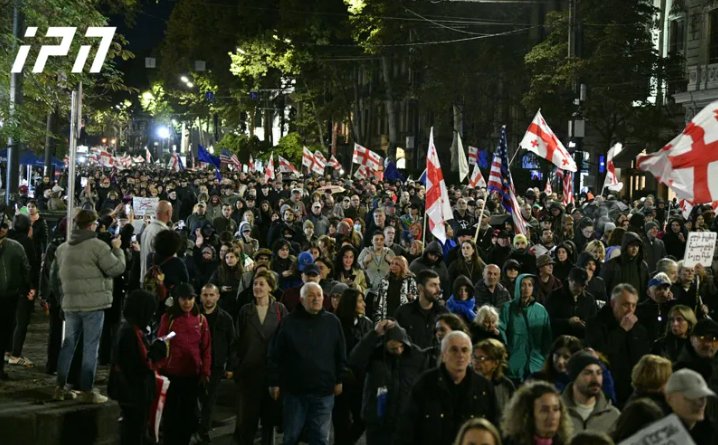
TBILISI, October 26 – Thousands of demonstrators poured into central Tbilisi on Sunday night, marching from Republic Square to parliament and shutting down traffic on Rustaveli Avenue as Georgia’s rolling anti-government protest continues.
Organizers repeated the same two demands that have defined the movement for months: call new parliamentary elections and free people detained during the rallies.
Former president Salome Zourabichvili joined the rally and tore into the government from the stage, calling it “total corruption” and telling supporters the “regime has already lost” and its “days are numbered.” She urged crowds to “hold on a little longer.”
She added, “do not surrender Georgia to the Russians, even if they are dressed in Georgian clothes,” referencing a common claim among opposition circles, that the ruling elite are cozy with the Kremlin. Branding political opponents as being in league with the Russians is common in Georgia’s heated political rhetoric.
The march, billed as “To the end, to victory,” began at Republic Square and ended outside parliament, where rallies have continued for nearly a year. Protesters unfurled a banner with the slogan and filled the avenue, halting vehicles while more groups streamed in to join the main crowd.
Levan Tsutskiridze, of the “Freedom Square” movement, said the opposition would escalate pressure and lay out next steps Monday morning. He told supporters they have “not gone anywhere” and will “continue the struggle until people’s demands are met,” arguing the fight now needs a “new stage” alongside street protests.
Tamar Chergoleishvili of the Federalists, a UNM spinoff, called for tighter organization. She asked backers to register on a “resistance page” to improve coordination, protection and feedback among activists, saying better planning is how to make protests “more costly” for the authorities.
From the same stage, former MP for the ruling GD party Gedevan Popkhadze argued that the country still has “political-legal” tools to force change without violence. He said rallies keep “full dictatorship” at bay and warned that if the government “stubbornly” turns into an “evil regime,” such regimes “end very badly.”
Giga Bokeria, a veteran of Saakashvili’s UNM government, told Interpressnews the protests will “continue and expand as necessary” until the ruling team accepts it must cede power. He said growth requires carrying “ideas and conviction” to parts of society not yet persuaded, and insisted activists will keep fighting using “every legitimate form” available.
Sunday’s march capped a week of tense road blocking protests in front of parliament. Sixty persons have been detained for up to fifteen days for administrative violations only the last three days, according to the Ministry of Internal Affairs. They were detained under tougher rules for public assemblies passed by parliament in February, which state that traffic cannot be blocked unless the size of the crowd necessitates it. Enforcement of those rules became harsher starting from October 17 due to a different legislative change.