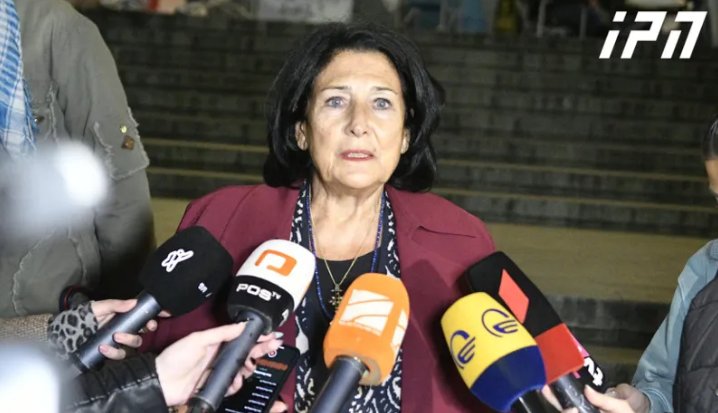
TBILISI, November 17 – Georgia’s ruling Georgian Dream party on Monday dismissed renewed opposition talk of forming a “technical government”, while former president Salome Zourabichvili accused the authorities of dragging the country toward isolation.
The clash began when Georgian Dream MP Tengiz Sharmanashvili ridiculed opposition calls for a temporary, non-partisan cabinet to oversee a political transition. Speaking to reporters, he said the idea was “not serious,” arguing that some opposition figures “still think Salome Zourabichvili is president” and treat her as a pro-American power broker. He mocked claims that parliament could dismiss the government, dissolve itself and trigger snap elections, calling it an “unimaginable narrative” and insisting that anyone who believes it cannot be helped.
Zourabichvili, who served as Georgia’s fifth president until the end of her term in December, 2024, fired back with a sharply worded Facebook post. She compared the government’s recent decisions to practices from the Soviet era, responding to parliamentary speaker Shalva Papuashvili’s announcement that the ruling party plans to block Georgians living abroad from voting in future parliamentary elections unless they return to the country to cast their ballot.
Zourabichvili listed what she called a pattern of state-driven isolation. She pointed to Georgia’s withdrawal from the Bologna Process, limits on student participation in European study programs, and now the move to restrict voting rights for emigrants. She added accusations of “isolation,” “repression,” and “elite privilege,” concluding with the claim that “the USSR was nothing else.”
The voting reform is part of a broader overhaul of Georgia’s election code. Papuashvili announced earlier Monday that the 2011 election law would be rewritten and simplified. The proposed rules would require all citizens to vote inside Georgia’s borders, similar to the system used for local elections. The opposition has condemned the reform as an attempt to silence the diaspora, but according to Papuashvili, this change would protect voters from foreign influence and ensure that elections are decided by people who are in touch with daily life in the country.
Alongside the election debate, several state institutions are now slated for closure. The government will dissolve the Anti-Corruption Bureau, the Personal Data Protection Service, and the Business Ombudsman’s office. According to the announcements made Monday, the Business Ombudsman’s apparatus will be shut down on January 1, 2026, with its functions transferred to the Ministry of Economy.
The moves come in a time period where the domestic political situation is difficult, with daily protests in central Tbilisi and legal proceedings against several opposition leaders. Internationally, relations are strained with the country’s Western partners. While the ruling GD party insists it is strengthening state sovereignty and reducing external interference, critics argue that the government is dismantling democracy and threatening the country’s relations with Europe.