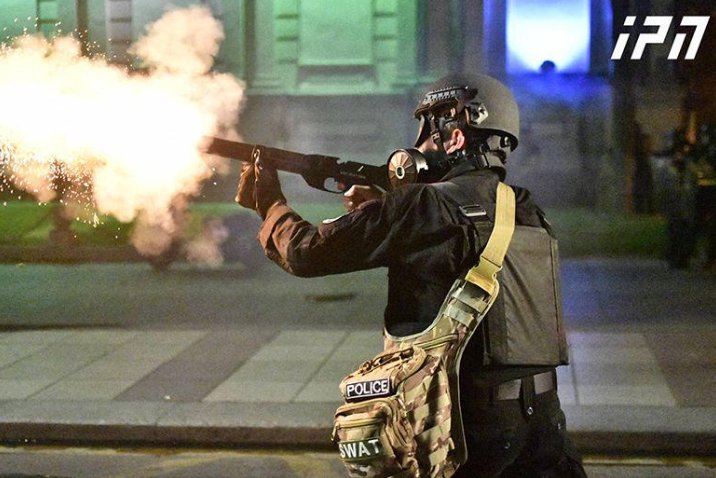
TBILISI, December 11 – Europe’s human rights court has ruled that Georgia was responsible for several violations during and after the breakup of a riot in June, 2019 dubbed the “Gavrilov Night”.
The court found Georgia at fault for excessive police force, botched investigations and breaches of free speech and assembly, while also confirming that the state had a legitimate right to use special means once the rally turned violent.
In its judgment in the case “Tsaava and Others v. Georgia,” the European Court of Human Rights (ECHR) said that on the night of June 20 to 21, 2019, police used rubber bullets and other force to disperse a large anti-government protest outside Parliament. The demonstration, involving about 12,000 people and policed by roughly 5,000 officers, erupted after a well-known member of Russia’s State Duma sat in the Georgian parliament speaker’s chair and addressed a conference in Russian. Most of the 26 applicants in Strasbourg were protesters or journalists who were injured, mainly by rubber bullets.
The court found that Article 3 of the European Convention, which bans inhuman or degrading treatment and requires an effective investigation, was violated in both its substantive and procedural aspects in respect of 24 of the 26 applicants. It also found breaches of Article 10, freedom of expression, for 14 applicants and Article 11, freedom of assembly, for 11 applicants. Article 38, which concerns states’ duty to cooperate with the court, was not violated.
Judges criticized the fact that the domestic investigation has dragged on for more than five and a half years without a full assessment of the circumstances. The ruling says Georgian authorities failed to draw clear conclusions about ill-treatment claims and did not identify the state agents who used excessive force or gave the orders. The court said there was no evidence that the injuries were an inevitable result of protesters’ conduct, and that police appeared to use rubber bullets as a general crowd control tool. Interference with journalists’ work was found neither proportionate nor justified. Even though the authorities had some grounds to disperse the rally, given that some demonstrators tried to storm Parliament, the way it was done was not justified and the level of force was excessive.
On compensation, Strasbourg ordered Georgia to pay material damages of 75,000 euros to two applicants and 85,000 euros to another two. All 26 are to receive varying sums for non-pecuniary damage, and 22 applicants are due 38,414.99 euros for costs and expenses. The state has three months from the judgment to pay.
Opposition politician Levan Samushia of Lelo said the decision reveals the true face of the current authorities, claiming they do not value people or human rights. He argued that the court confirmed there had been no effective investigation under the article on torture, and described this as deliberate non-investigation that denied justice to citizens who were beaten and allegedly ill-treated.
Former prime minister and ex–interior minister Giorgi Gakharia, who was in charge of the police at the time, is at the center of a separate criminal case launched in Georgia this November. His party, For Georgia, took almost the opposite line to Lelo. Party figure Berdia Sichinava welcomed the judgment as proof that the state had a legitimate right to use special means to repel attacks on police and state institutions, while acknowledging that there were disproportionate uses of rubber bullets in some cases. He said case materials and the ECHR ruling confirm that Gakharia did not issue the order to use rubber bullets and called the charges against him fabricated and politically motivated. His party plans to present the Strasbourg judgment as evidence in his defense.
Justice Minister Paata Salia, speaking for the government, also highlighted the parts of the ruling that confirm the state’s right to use special measures against violent attacks, saying the court “once again” affirmed this. He acknowledged that the judgment points to investigative shortcomings and instances of disproportionate force, but stressed that prosecutors had already stepped up the probe after an earlier ECHR decision in 2024, which led to criminal proceedings against Gakharia in November 2025. In his view, the ruling puts an end to claims that Gakharia is the target of political persecution.
Parliament’s legal affairs committee chair Archil Gordulaze underlined that the court described June 20 as a violent rally with a storm on Parliament and said it was important that everyone responsible for human rights violations, including Gakharia, be held to account. Gakharia’s allies, by contrast, say the real offenders have still not been identified and insist the Strasbourg ruling is their strongest card yet.