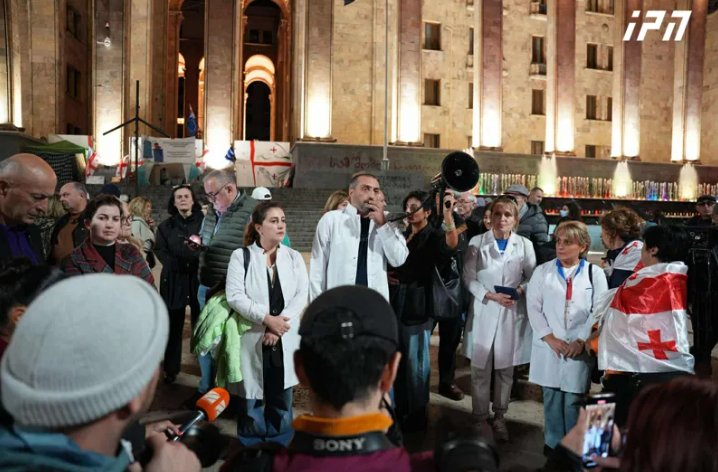
TBILISI, October 11 – Tbilisi City Court has spent the week holding tense hearings that ended Friday with doctors rallying in downtown Tbilisi, as international criticism mounts over the aftermath of the October 4 unrest.
On Friday, Georgia’s capital saw two marathon court sessions, with judges sending another dozen defendants into pre-trial detention over the violent scenes outside the president’s residence. Prosecutors said the group damaged fencing and tried to enter the compound, while defense lawyers argued their clients were peaceful protesters and that the trials are politically motivated.
Among those remanded were Mamuka Labuchidze, Konstantine Kokaia, and Zurab Chavchanidze. Inside the courtroom, tempers ran high, while outside, police briefly clashed with supporters.
Later that evening, on Rustaveli Avenue, doctors in white coats held candles and photos of their 71-year-old colleague, Dr. Giorgi Chakhunashvili, one of the accused. Prosecutors had recommended bail instead of detention, but his arrest shocked the medical community. “He’s a doctor, not a criminal,” one protester told Interpressnews.
By Saturday, the number of people detained in connection with the October 4 rally had risen to 46, while prosecutors filed charges against 17 more. The expanding list now includes activists, students, and professionals, sparking a debate over whether authorities are overreaching or simply enforcing the law equally, regardless of status or profession.
Former defense minister Bacho Akhalaia was questioned for nearly eight hours on Friday. He told reporters afterward that investigators were comparing voice samples tied to an audio recording. His wife, Ani Nadareishvili, was later questioned at the State Security Service. Both deny any connection to alleged “safe houses” mentioned in the so-called Hexogen case, in which two Ukrainians were arrested while trying to bring explosives into Georgia before last weekend’s local elections.
Friday, OSCE Parliamentary Assembly Special Representative on the South Caucasus Luís Graça, expressed deep concern about the “growing tensions and violence” after the local elections and urged all stakeholders to refrain from any form of violence. Describing “announced efforts to overturn the government,” he called on all political forces to “commit to working through legitimate political processes,” an apparent criticism directed at the Georgian opposition.
Meanwhile, the Georgian Dream government kept up its combative tone. Parliament Speaker Shalva Papuashvili said no profession would shield suspects from responsibility, while Tbilisi Mayor Kakha Kaladze accused Western officials of “selective sympathy.”