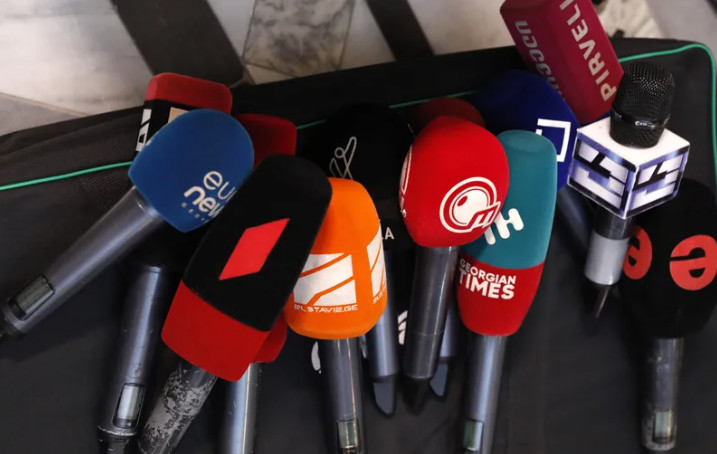
EXPLAINER: A claim that Georgia has banned journalists from using 93 words and phrases has spread quickly through the country’s opposition and civil society circles. But is that claim actually true?
A closer look at the Communications Commission’s rulings reveals that what it has sanctioned, is broadcasters presenting political viewpoints as the station’s own factual news reporting, not saying particular words.
Transparency International Georgia published a report Friday saying the Communications Commission had effectively prohibited critical broadcasters from using 93 words and phrases, including “regime,” “oligarch,” “political prisoners,” “Ivanishvili’s prime minister,” “unlawful imprisonment,” “repressive laws” and “judicial clan”.
According to the report, Formula and TV Pirveli have faced seven proceedings over the past six months, with sanctions escalating from warnings to fines of GEL 2,500, GEL 5,000 and, most recently, GEL 10,000.
Commenting on the report, former president Salome Zourabichvili repeated the “banned words” claim on X, saying the Commission had prepared a list of words Georgian media were “not allowed to use.” Transparency International Georgia director Eka Gigauri similarly wrote that the regulator had “banned 93 words/phrases on critical TV.”
The Commission’s published decisions, however, do not describe a blacklist of forbidden vocabulary.
In its June ruling against TV Pirveli, for example, ComCom said the broadcaster had violated Article 54(5) of the Broadcasting Law because presenters and journalists had expressed political assessments as their own views in news programmes. Crucially, the Commission explicitly distinguished those statements from quotations or assessments attributed to third parties.
In other words, a phrase such as “political prisoner” or “oligarch” is not prohibited as such. A broadcaster can report that an opposition politician, activist or other source used that description. The issue arises when an anchor or reporter adopts the characterization as the broadcaster’s own statement of fact in a news programme.
This distinction appears repeatedly in ComCom’s rulings. The regulator says broadcasters may not cover political disputes or current public-policy issues on the basis of their own opinions or attitudes. Its October 1 decision fined Formula GEL 10,000 after finding that presenters and correspondents had again inserted personal assessments into its 5 p.m.
But clarifying what the rulings mean does not make them less controversial, as what stands out in ComCom’s rulings is the state’s interference into editorial decisions and the encroachment on the freedom of the media. Amendments adopted in April 2025 gave the Communications Commission power to enforce standards including impartiality, accuracy and the separation of fact and opinion. As in most democracies, this area was previously largely handled through broadcasters’ own self-regulatory mechanisms, but last year came under the purview of the state.
Transparency International Georgia argues that the Commission is using those powers as a censorship tool against critical television stations and that the accumulating fines threaten already financially strained broadcasters.
However, the Commission has also applied the impartiality rules to pro-government broadcasters. In April it issued warnings to Imedi and POSTV alongside TV Pirveli and Formula after finding examples of anchors and reporters expressing personal opinions in news coverage. POSTV was later fined GEL 2,500 for similar violations.
The 93-item list is better understood not as a government dictionary of forbidden words, but as Transparency International Georgia’s compilation of language that appeared in broadcasts the Commission found to cross the line between reporting and editorializing.