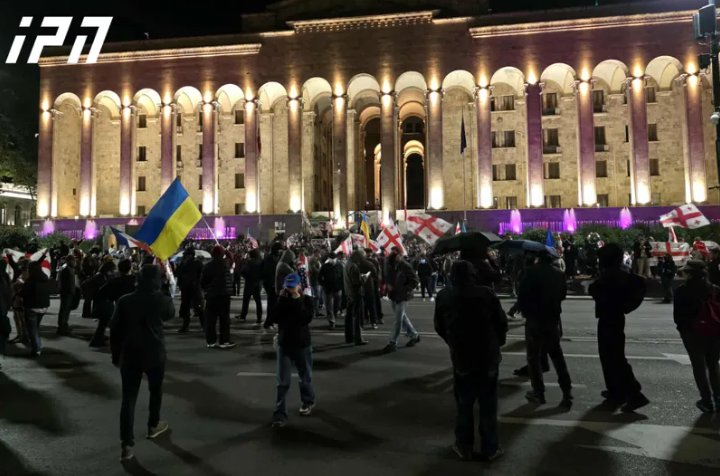
The big problem with news coverage of Georgia is that a small cluster of foreign-funded NGO media platforms have come to dominate English-language reporting on the country while presenting themselves as neutral journalism.
International media benefit from this arrangement. They get English-fluent intermediaries ready with quotes, angles and ready-made narratives. The NGO platforms benefit too, because this gives them influence far beyond their real standing inside Georgian society, where opinion polls have shown them to be among the least trusted groups.
How did this happen? After the 2003 Rose Revolution, Georgia’s state institutions were heavily shaped by foreign-backed reform projects. The judiciary, the executive and even the legislature (through debate practice for youth politicians) were all trained by Western advisors and supported with millions in taxpayer funding from Europe and the United States.
The fourth estate was drawn into this world too, oddly enough. Georgia already had a lively post-Soviet media scene: unruly, confrontational, often broke, but very much alive. Newspapers survived largely on public ads. Television was also active before the reforms. Rustavi 2 helped bring about the political change of 2003.
Georgia did not begin with a media vacuum. Yet a cluster of foreign-funded NGO platforms sprang up and began claiming the mantle of democratic journalism.
What, exactly, have they added? A free press is supposed to widen debate. It should publish arguments, assumptions and interpretations from different sides, especially in a polarized country. That is not how Tbilisi’s NGO media sphere works.
Look at the opinion pages of outlets such as JAMnews and Civil.ge. The pattern is clear: Georgian Dream is the problem, Russia is the villain, the EU and NATO are virtuous, and the dispute is mostly about how and how fast Georgia should move in that direction. JAMnews’s recent opinion pieces on the grants law, Georgian foreign policy, the Aliyev–Ivanishvili meeting and Hungary’s election all come from the same general angle. Civil.ge’s recent op-eds show the same pattern: criticism of Georgian Dream, criticism of its foreign policy, criticism of its education policy, and an interview with opposition figurehead Salome Zourabichvili.
Georgian media have always been partisan. The issue here is not partisanship as such. The issue is that a narrow, foreign-funded English-language media cluster is presented abroad as neutral journalism while filtering out large parts of Georgian political reality.
It is, of course, free to do so. But when nearly all the opinions carried reflect the same worldview, one that sits at odds with much of the electorate, readers are bound to wonder whether they are looking at news or advocacy. Add foreign funding, and you question on whose behalf the advocacy is being done.
Yes, there are also Russia-aligned platforms. But they do not enjoy the same legitimacy, prestige or gateway role in international reporting on Georgia. That role has largely fallen to the Western-funded NGO media sphere.
Georgian Dream has now held power for nearly 14 years and has won repeated electoral support. We may dislike that fact. We may think those voters are mistaken. But a media sphere that claims democratic legitimacy cannot go on failing to represent, in any serious way, the worldview that has carried the ruling party to victory time and again.
This matters especially now, when the government’s legal moves against foreign-funded NGOs are defended by Georgian Dream as a way to curb outside influence and let a more homegrown civic sphere develop. Those arguments should be examined, challenged, tested and dissected. But they should also be presented fairly. Too often, NGO media platforms skip that step. They do not engage the logic of the other side. They filter it out.