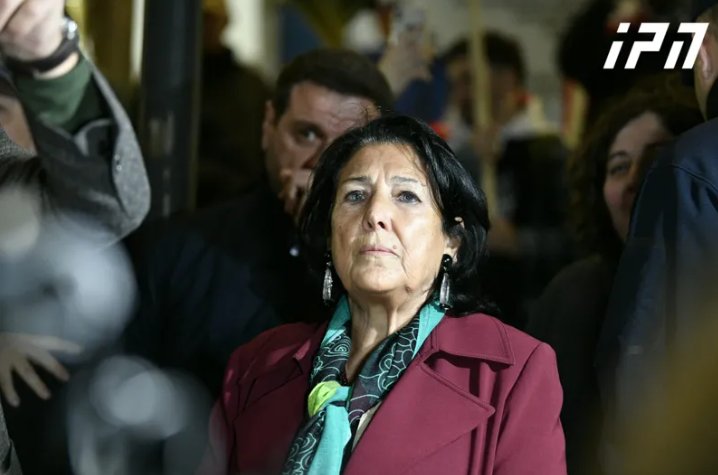
TBILISI, November 26 – Georgia’s former president Salome Zourabichvili is signaling that she may make another attempt to unite the country’s fragmented opposition, after comments she made during a visit to France.
Speaking at a Paris university, Zourabichvili argued that the current moment calls for coordination between political parties and civil society. She said the opposition is weakened, lacks resources and operates under what she described as difficult conditions, adding that the priority should be achieving new parliamentary elections.
Just as the opposition is preparing for a mass rally later today, her remarks have caused some to question whether there is a new political push in the offing. Political analyst Ramaz Sakvarelidze told Rezonansi that her earlier initiatives failed to gain traction inside the opposition. In his assessment, she struggles to rally the public because she lacks the kind of political charisma that often helps leaders unify competing camps.
Zourabichvili’s first major attempt came in May 2024 while she was still president. Standing outside the presidential residence at Atoneli Street, she introduced what she called the “Georgian Charter.” The proposal demanded that the ruling Georgian Dream step aside and allow an interim administration recruited from non-governmental organizations (NGOs) to reform the election code and prepare new elections. Despite weeks of talks with opposition parties, the plan collapsed.
Her second initiative was unveiled in February this year under the name “Road to New Elections.” It repeated the call for Georgian Dream to voluntarily give up power and for an interim government to organize new parliamentary elections. This attempt also failed.
Since leaving office in December 2024, Zourabichvili’s political role has been ambiguous. The opposition wanted her to stay in office beyond her legal term and defy the expiration of her mandate, but she stepped down at the last moment. After her departure she claimed she still held presidential legitimacy, though such statements have become less frequent as her influence has faded.
She briefly reappeared in political coverage during the legal proceedings of jailed editor Mzia Amaghlobeli, whose appeal was recently rejected by the Kutaisi Court of Appeals. Her interventions drew attention but did not change the political landscape.
Once a French-born diplomat who served as foreign minister after the 2003 Rose Revolution, Zourabichvili entered high-level Georgian politics with the backing of the Georgian Dream coalition, which supported her run for the presidency in 2018. As president, she later distanced herself from the ruling party and aligned more closely with Tbilisi-based groups critical of Georgian Dream’s direction.
Analysts describe her current efforts as part of a broader sense of crisis within the opposition, which has been weakened by internal splits, lack of funding and the imprisonment of several leaders. Sakvarelidze noted that many in the opposition do not see Zourabichvili as a potential unifying figure, especially after several unsuccessful initiatives. He compared her to former prime minister Zurab Zhvania, a respected and loved politician who nonetheless, in his view, was simply not charismatic.
READ ALSO: Georgia’s opposition prepares for showdown one year after EU freeze