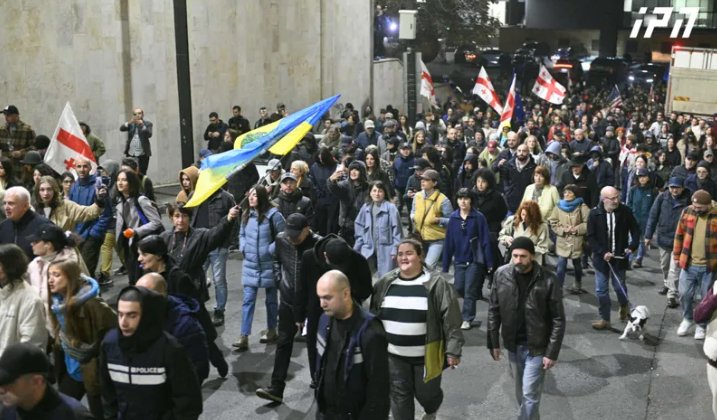
TBILISI, November 13 – As Georgia’s ruling party insists that no genuine protest movement exists in the country, claiming only small foreign-funded groups gather on Rustaveli Avenue each evening, analysts and opposition figures are debating whether the public mood could soon shift toward wider unrest.
Over a year has passed sine a disputed election triggered an opposition boycott of parliament and a movement to unseat the government backed by Western leaders. Crowds have been gathering on Rustaveli Avenue every night, demanding snap elections, but results are meager. Now, experts are debating why the efforts have – so far – not generated a nationwide protest wave.
The opposition argues that most Georgians support them and that new demonstrations are being planned. But political observers are divided on whether the growing discontent over living conditions can evolve into a mass movement.
Veteran political analyst and former dissident Vakhtang Dzabiradze told Rezonansi that public frustration is real but dormant. In his view, most people are not yet ready to take to the streets the way they did during protests against former president Mikheil Saakashvili. “There is public anger, but not enough organization or unity in the opposition to channel it,” he said. He believes opposition parties need to win people over with clear goals and realistic programs rather than nostalgia for the past or constant criticism of the ruling party.
Dzabiradze added that if opposition groups fail to learn from their own mistakes and remain fragmented, split among factions loyal to Saakashvili’s United National Movement, Giorgi Gakharia’s party, Lelo, and Akhali, then any protests that do erupt could be chaotic or even dangerous. “If an external factor acts as a detonator, protests could spiral out of control,” he warned.
Political scientist Petre Mamradze, on the other hand, says talk of public anger is exaggerated. “There is no real protest mood in the country,” he argued, noting that social and economic conditions, while difficult, have not reached crisis levels. He described the nightly demonstrations in Tbilisi as “performances” by a small, well-funded circle that relies on sympathetic television networks and social media to exaggerate its reach. “Even at their peak, they gathered barely two thousand people in a city of 1.5 million,” he said.
Mamradze suggested that opposition activism today is driven more by necessity than conviction. “They have no way back,” he said, pointing to what he described as heavy reliance on Western donors and political contacts in Europe. “Many of them have made a living from this work, and they can’t stop even if the public isn’t responding.”
Both analysts agreed that the Georgian opposition faces a fundamental problem of credibility. Dzabiradze argued that opposition parties should focus on bread-and-butter issues like the economy and social welfare instead of framing every debate around ideology or geopolitics. Mamradze went further, saying Georgia’s political scene has lacked a charismatic leader since Bidzina Ivanishvili’s rise to power in 2012. “For 13 years, there has been no Messiah figure, and that’s exactly what Ivanishvili promised,” he said.