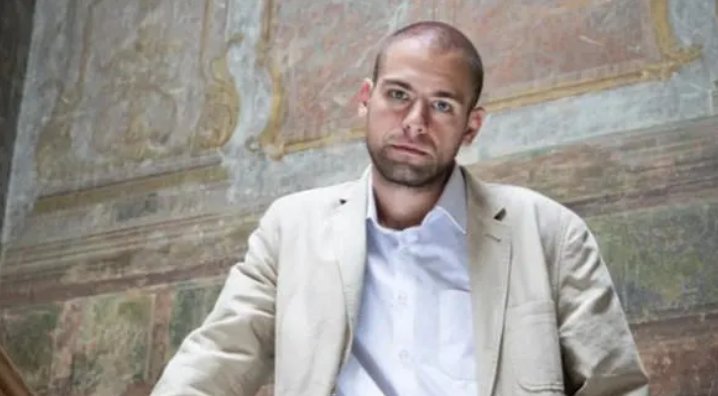
TBILISI, January 29 – A Georgian actor who is on the cast of a Hollywood movie still sits behind bars, but his case was up for appeal Thursday.
Actor Andro Chichinadze is one of 11 defendants in a case about anti-government protests who were arrested in December, 2024, following social unrest in the wake of the parliamentary election.
Chichinadze is listed as a cast member in Hotel Tehran, playing a U.S. Marine in the upcoming American action film featuring Liam Neeson.
On Thursday, Jan. 29, 2026, Georgia’s Tbilisi Court of Appeals heard the latest round of arguments in the case, with prosecutors asking the court to keep Chichinadze and the other defendants in custody.
Prosecutors told the appeals court that materials in the case show the defendants took part in group violence, while defense lawyers said the prosecution still does not have enough proof and that the arguments presented are unsubstantiated.
Some defense lawyers, as well as Chichinadze himself, asked the court to present the results of forensic examinations of mobile phones, saying the findings could show whether the convicted men were in contact with each other and whether the alleged crime was coordinated.
The next hearing is scheduled for February 5.
Chichinadze was detained on Dec. 5, 2024, after media reported that a search was carried out at his home and police arrested him there. At the time, the charge was not yet publicly known, according to a report by Interpressnews at the time.
The next day, Chichinadze’s father said police acted “within the bounds of correctness” during the detention, but argued the arrest looked like a public example because his son is a well-known figure.
Within days, the case moved into court. On Dec. 7, 2024, a hearing involving Chichinadze, comedian Onise Tskhadadze, and several other detainees took place at Tbilisi City Court, with supporters from the theater world and other fields arriving at the courthouse.
By Jan. 10, 2025, a judge ruled that Chichinadze, Tskhadadze, and nine others accused of taking part in group violence during protests would remain in detention.
The case continued through 2025 with multiple hearings. In March 2025, the court held a pretrial session on the case involving Chichinadze, Tskhadadze, and the other defendants.
Throughout the proceedings, the defense and prosecution have presented sharply different versions of what the evidence shows. At different points in 2025, Chichinadze publicly argued that the accusation was unclear and insisted prosecutors would not find what they claim the defendants did. He also criticized public commentary about the case, describing it as a violation of the presumption of innocence.
A major turning point came on Sept. 3, 2025, when Tbilisi City Court delivered a verdict in the case. The court found the 11 defendants not guilty of the charge they were originally arrested under, which was participation in organized group violence under an article of Georgia’s Criminal Code that charge carries a potential sentence of 4 to 6 years.
However, the judge reclassified the case under a different article of the criminal code, as active participation in a group action that violated the public order, and found the defendants guilty under that reclassified charge. Each was sentenced to two years in prison.
Both sides appealed: prosecutors have argued the defendants should be found guilty under the original, tougher charge, while the defense has argued for full acquittal.
After the September, 2025 sentencing wave, Amnesty International criticized Georgia’s use of prison sentences for demonstrators, including Chichinadze, urging the authorities to overturn what it called unfair verdicts and accusing the government of using the justice system to punish protest and suppress dissent.