TBILISI, November 13 – Four more detainees who were facing five years in prison after the October 4, 2025 rally will be released in December after reaching plea agreements with prosecutors.
Freeing the detainees has been one of the main demands at daily opposition protests since the 2024 parliamentary election. These latest releases continue a trend – first reported by DFWatch – whereby those detained during political protests began to gradually be released, fulfilling one of the Georgian opposition’s main demands.
The Tbilisi Court of Appeals approved the deals Tuesday for Davit Sturua, Davit Zhgenti, Konstantine Kokaia and Kakhaber Mzhavanadze. Their five-year sentences were replaced with one year and two months in prison, followed by two-year suspended terms.
All four admitted guilt as part of the agreements. They had been convicted of participating in group violence and attempting to seize a strategically important facility.
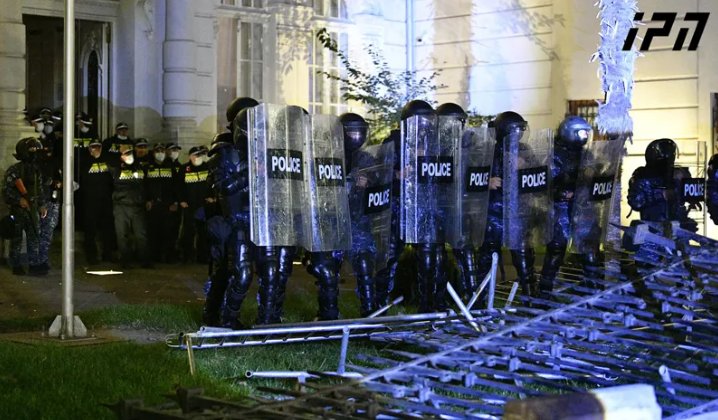
The protest on October 4, 2025, took place outside of the presidential palace, on Atoneli Street in downtown Tbilisi.
The first major agreements came in June, when 22 defendants received suspended sentences. Twenty-one were able to leave the court building freely after spending months in pretrial detention, while another had previously been released on bail.
A separate group of 12 received shortened prison terms later that month. Since September, agreements have also been reached with people initially sentenced to between five and seven years, including opposition figure Murtaz Zodelava, former military officer Lasha Beridze and activist Nana Sander.
Three October 4 defendants were also among protesters pardoned by President Mikheil Kavelashvili in August.
Plea agreements as such are not the same as being acquitted. Defendants who sign them must admit to the charges and express remorse, and then prosecutors will accept a deal. Some defendants have refused to do that, maintaining that they were unjustly prosecuted.
The October 4 unrest took place on the day of Georgia’s partially boycotted municipal elections. Organizers called for what they described as a “peaceful revolution”, which started at Freedom Square. Some of the protesters walked a few hundred meters over to the presidential palace, where some demonstrators broke through the barriers erected in front of the entrance and attempted to force their way through to the compound, before being repelled by riot police.
Georgian Dream described the events as an attempted overthrow of the government. Opposition figures and activists disputed that account, despite UNM leader Levan Khabeishvili beforehand calling it outright a revolution. They accused the authorities of using the prosecutions to punish political opponents.
Releasing people imprisoned over anti-government demonstrations has been one of the protest movement’s main demands since the 2024 parliamentary election, which the opposition refused to recognize, prompting many parties to refuse to take up their seats in the national assembly.
The growing use of plea agreements has to some degree addressed the opposition’s demand to release detainees. It has also changed the grim prospects faced by opposition activists until recently, where many were looking at long prison terms, although no wider reconciliation policy has been announced.
Several defendants remain imprisoned, while others convicted in absentia remain outside Georgia or are wanted by the authorities.