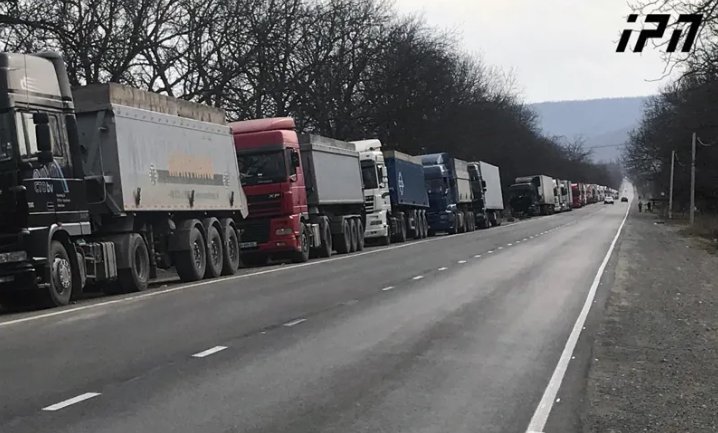
TBILISI, November 3 – Freight traffic through Georgia’s main transit corridor has fallen sharply this year, with thousands of trucks bypassing the country due to long delays at its northern border crossing with Russia.
According to data from Georgia’s Transport Corridor Research Center, the number of trucks passing through Georgia dropped by more than 22,000 in the first nine months of 2025, cutting state revenue from transit fees by nearly 8 million lari (about USD 3 million).
Between January and September, 357,145 trucks crossed Georgia, compared with 379,970 during the same period last year. Income from truck transits fell from 132.9 million lari in 2024 to 125 million in 2025.
The head of the Transport Corridor Research Center, Paata Tsagareishvili, said the decrease reflects a combination of factors but is mainly driven by severe congestion and inefficiencies at the Upper Lars checkpoint, the only operational land crossing between Georgia and Russia.
“Freight flows are being lost because customs procedures on the Georgian side at Upper Lars are delayed,” Tsagareishvili told BPN. “Queues sometimes last up to two weeks. Many drivers say the problem comes from slow processing by Georgian border officials and organizational or infrastructure issues.”
Upper Lars has become a vital link since the start of the Russia-Ukraine war in 2022, when Western sanctions pushed more Eurasian trade through Georgia. Tsagareishvili noted that transit volumes initially surged by around 50 percent that year and were expected to keep growing by 10 to 15 percent annually. Instead, the trend reversed in 2025.
Frustrated by the waiting times, transport companies are turning to alternative routes. Some now ship goods by ferry from Turkey directly to Russia, bypassing Georgia altogether. Others are rerouting via Iran and Central Asia, which, although longer, avoid the two-week bottleneck.
Adding to the slowdown, Russia has begun strictly enforcing its rule that deports foreign truck drivers who exceed the 90-day stay limit. Tsagareishvili said many drivers from Armenia and other countries are now parking their trucks temporarily to avoid deportation, further reducing traffic through Georgia.
“The market has partly stabilized, and transporters are looking for new directions,” he said. “Those two-week delays at the Georgian border are enough to push many toward longer but more predictable routes.”