Who wouldn’t want to be a fly on the wall when a Western politician sits down with Georgia’s foreign minister, Maka Botchorishvili, and gets a rude awakening: the version of events fed to them back home bears little resemblance to reality?
This month offered a fascinating case study in how that gap can occur.
It started with Transparency International Georgia, one of the country’s best-known non-governmental organizations. TIG dropped a juicy claim: Georgia’s media regulator had banned critical TV channels from using 93 words and phrases. “Regime.” “Oligarch.” “Political prisoners.” “Judicial clan.”
NGO-friendly outlets seized on it, as did opposition politicians, including former president Salome Zourabichvili, who declared that the regulator had drawn up a list of words Georgian media were “not allowed to use.”
We then saw AFP repackage the claim in a wire report for a global audience: “Georgia accused of banning critical words on TV.” The agency attributed it to TIG but treated the supposed ban as reality, calling it “a further tightening of restrictions on dissent.”
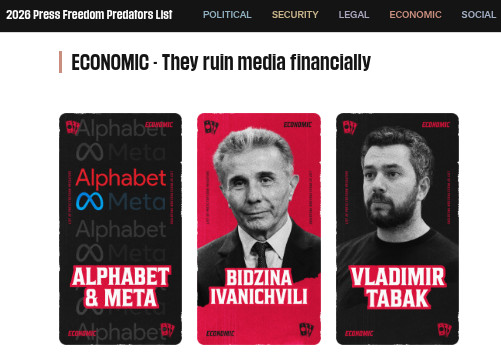
This week, Reporters Without Borders joined in. Naming Bidzina Ivanishvili a “Press Freedom Predator,” RSF accused him of manipulating the regulator and “going so far as to ban” Formula and TV Pirveli from using expressions critical of the government.
There’s just one problem. No such blacklist exists.
The Communications Commission never issued one. TIG built the 93-item list by mining language from seven proceedings against Formula and TV Pirveli. The regulator sanctioned the broadcasters for mixing political opinion into news reports and presenting contested descriptions as established fact. It did not outlaw the words.
A TV station can still report that someone called a detainee a “political prisoner.” What a newsreader cannot do, according to the commission, is adopt that loaded label as the station’s own neutral truth.
That is still serious. State fines for editorial language are heavy-handed and constitute pressure on press freedom. In most democracies, newsrooms police that line themselves.
Which is exactly why it is so counterproductive when groups like RSF recycle the most dramatic, least accurate version of the story. The grain of truth gets inflated into a cartoon of censorship, which next becomes the official international narrative.
That’s how the machine works: It starts with a real event. An advocacy group spins it into a compelling drama, which goes viral, receiving increasing recognition from politicians and opinion-makers along the way, until an international wire service gives the claim its blessing and a prestigious global organization writes it into the historical record. That’s the version that forms the “factual” basis on which Western politicians act, and why their chats with Botchorishvili ought to be fascinating.
But fantastical claims need not be popped like a balloon only behind closed doors. They can be popped here, in public.
All it takes is one pin: the facts.
That is what we will continue to provide.