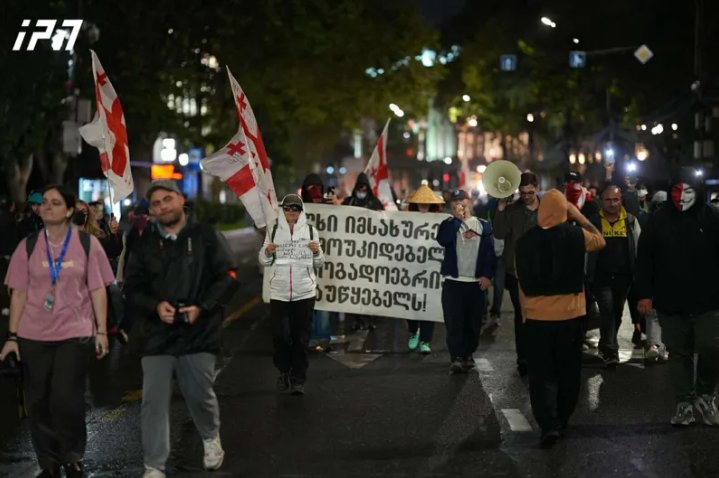
TBILISI, October 15 – Georgia’s parliament opened debate Wednesday on a government-backed bill that would sharply increase penalties for unauthorized protests, introducing the harshest restrictions on street demonstrations in years.
The proposal is part of a set of three legislative packages now being reviewed under an accelerated procedure.
Under the new draft, people taking part in rallies that block roads or use temporary structures could face up to 15 days of administrative detention, while organizers could face 20 days. The same penalties would apply to participants who wear face masks or carry tear gas or other irritant substances during a protest.
Administrative detention is a remnant of Soviet police powers to respond quickly to public threats, similar to UK anti-terror laws, that were used extensively under UNM’s rule. The current GD government restricted their use, but fell short of an election promise to do away with such measures.
Those who attend an assembly that the Interior Ministry orders to disperse could be detained for up to 60 days, even on a first offense. A second violation could bring criminal prosecution and up to one year in prison, while a third or subsequent offense could lead to up to two years behind bars.
The bill would also create a new criminal article punishing anyone who insults or disobeys police three times, adding another layer of penalties for protesters. The ruling party argues the reforms are meant to uphold what it calls the principle of democracy, preventing small groups from “imposing their will on the majority.”
The proposal follows months of tension and sporadic street demonstrations in Tbilisi and other cities. Government officials say fines and short detentions under current law have not been “effective enough,” and that tougher measures are needed to maintain public order. Opposition parties and rights advocates, however, have warned that expanding police powers could restrict freedom of assembly.
In addition to the protest bill, lawmakers are also considering a proposal to bar individuals linked to political parties found in violation of the constitution from holding public office, joining any party, or creating a new one. Parties that accept such individuals could be deregistered and fined.
Another draft would restrict foreign travel for people convicted of economic or financial crimes until they fully repay damages. The measure would apply automatically, without requiring a specific court order, and could be paired with asset confiscations and electronic monitoring.