TBILISI, October 5 – Georgia’s prime minister Irakli Kobakhidze warned harsh consequences after last night’s violent protest, branding it as an “attempted coup,” and said it could give grounds for banning the largest opposition party.
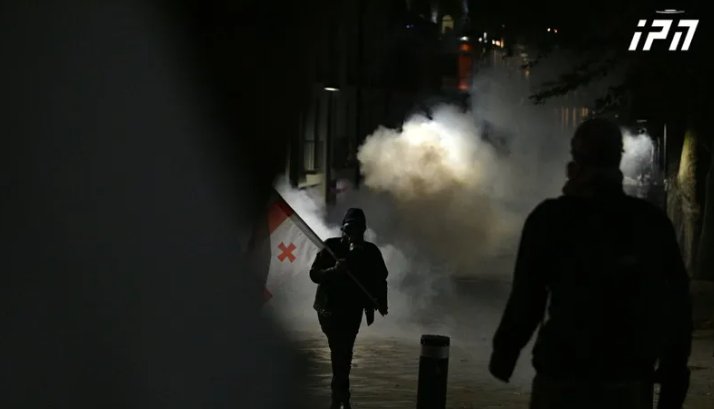
The night saw chaos and confrontation after precincts had closed in an election that gave the ruling Georgian Dream party a resounding victory but was boycotted by much of the opposition. Opposition supporters clashed with riot police near the presidential palace in what organizers had called a “peaceful revolution.” The protest began on Rustaveli Avenue and later spilled toward Orbeliani Square, turning violent after demonstrators attempted to storm security barriers.
According to the Interior Ministry, police used water cannons and tear gas after protesters broke through fences and set barricades ablaze using chairs and tables. Demonstrators chanted “to the end” while others threw objects at riot police. Six protesters and twenty-one officers were hospitalized, with one officer in critical condition. Around thirty others received treatment at the scene, the Health Ministry confirmed.
Organizers initially rallied outside parliament before urging the crowd to march toward the presidential palace, declaring they would “begin Georgia’s return by reclaiming the president’s residence.” The unrest intensified once several opposition figures, including Murtaz Zodelava of the United National Movement (UNM), urged supporters to escalate the protest. Zodelava later told journalists before his arrest that the unrest was his “personal uprising” and that he did not regret it. Police detained him and fellow UNM member Irakli Nadiradze on Rustaveli Avenue.
Prime Minister Irakli Kobakhidze condemned the events, calling them “an attempted coup” and warning that those involved “will face the full weight of the law.” He said many participants, including public figures who later distanced themselves, would still bear political responsibility. Kobakhidze added that attempts to overthrow the constitutional order could provide new grounds for seeking to ban the UNM as an unconstitutional party.
Ombudsman Levan Ioseliani urged restraint, noting that “power changes hands in democratic countries through elections,” and warned that anyone calling for the violent overthrow of government could face prosecution.
By dawn, police had cleared Orbeliani Square, and traffic resumed on Rustaveli Avenue. Authorities said most participants in the clashes had been identified, while investigations continue under the criminal code’s article on group violence.
Meanwhile, reports emerged that former opera singer and opposition figure Paata Burchuladze was taken to hospital during the protests. Police later arrived at the clinic for questioning, though details remain unclear. In a separate development, the Interior Ministry confirmed the arrest of Ruslan Shamakhia, a former regional security chief, on weapons-related charges.