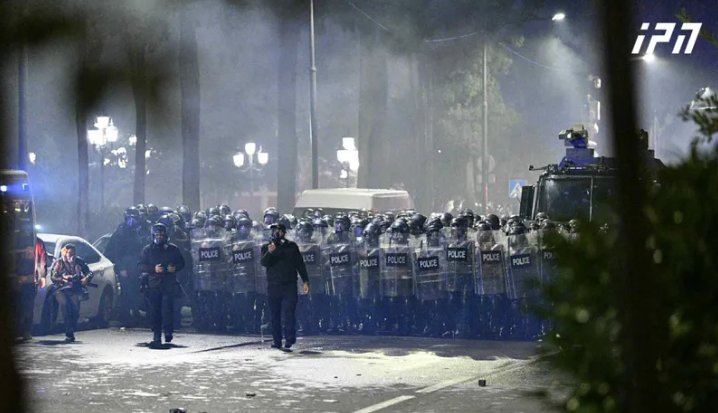
TBILISI, October 9 – Georgia’s ruling party says the idea of revolution is over, and it no longer expects large-scale protests after the failed October 4 rally in Tbilisi that ended with clashes outside the presidential residence.
Government officials and analysts close to the ruling Georgian Dream (GD) party now argue that the political momentum is gone. “The idea of overthrow and revolution ended on October 4,” one government source told the newspaper Rezonansi. Western partners, meanwhile, are described as maintaining a cautious distance — skeptical of the opposition’s strength, but still critical of the Georgian government’s tone and policies.
Prime Minister Irakli Kobakhidze, speaking Tuesday, criticized Western silence over what he called an “attempted violent storming” of the presidential palace. He said neither the United States, European Union, nor any Western organization condemned what the government described as an effort to overthrow the elected authorities. “Not condemning violence can easily be interpreted as its indirect but clear endorsement,” Kobakhidze said.
Analyst Zaal Anjaparidze told Rezonansi that he does not expect the EU’s tone to soften in the near term, though he noted that Washington’s restraint is telling. “The U.S. State Department hasn’t commented at all, and that in itself is significant,” he said. “They might not acknowledge it openly, but by staying silent they have to some degree accepted the election results.”
According to Anjaparidze, Georgian Dream will now focus on signaling to Western governments that it controls the situation and guarantees stability. “The EU doesn’t want turmoil in Georgia,” he said, “but it also doesn’t want to appear to legitimize the government too easily.”
Political analyst Davit Zurabishvili, a former MP, agreed that normalization with the West is unlikely soon. “This depends on how the government treats those detained after October 4,” he said. “If they continue arrests and bans on parties, there will be no improvement.”
Anjaparidze added that Georgian Dream’s position toward the West will depend on whether Brussels and Washington moderate their stance. “If the West compromises, the government can also maneuver,” he said, but ruled out any repeal of controversial laws on foreign-funded NGOs, which mirror similar legislation in the U.S. and U.K.
Zurabishvili, by contrast, said the government sees Europe mainly as a commercial partner, not a community of shared democratic values. “For Georgian Dream, Europe is where the money is,” he said. “They want trade and investment, not integration. But if you’re at odds with Europe, you lose relevance even for the East.”