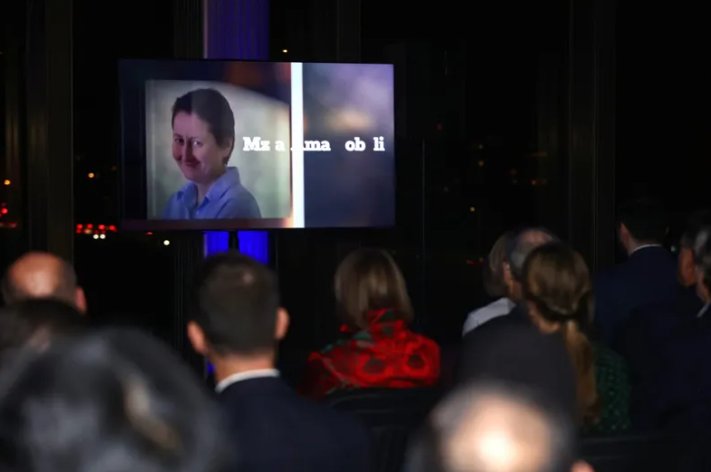
TBILISI, November 19 – A Georgian appeals court has upheld a two year prison sentence for editor Mzia Amaghlobeli.
Amaghlobeli is the founder of two independent outlets, Netgazeti and Batumelebi. On 6 August she was convicted under Article 353, part one, of Georgia’s Criminal Code, which covers resistance, threats or violence against a law enforcement officer or other public official.
The court sentenced her to two years in prison, within a possible range that runs from a fine or up to two years of house arrest, to between two and six years in prison for more serious cases.
The case stems from an incident in Batumi where Amaghlobeli slapped a local police chief in the face, an act that was filmed and aired on Georgian television. Prosecutors argued that this amounted to violent resistance against a senior officer and, at the appeal stage, asked for her conviction and punishment to be toughened further. Her lawyers countered that the existing verdict should be thrown out and she should be released.
On Tuesday the Kutaisi Court of Appeals left the original verdict in place. Amaghlobeli attended the hearing, which drew supporters and the country’s former president Salome Zourabichvili. According to local media, people in the courtroom chanted “Freedom for Mzia” before and after the session, underscoring how the case has become a rallying point for critics of the ruling party.
Before the judgment, Amaghlobeli addressed the judges. She said she does not fear prison itself as much as the question of what kind of country she will return to once she is released, and she urged people to keep fighting for constitutional rights and human dignity. Her lawyers say she has already paid a high personal price, including a year spent in detention and damage to her eyesight.
Outside the courtroom, Zourabichvili called the decision a tragedy for the country and praised Amaghlobeli as a symbol of dignity and courage. The former president said she believed that a future legitimate president of Georgia would award the journalist one of the state’s highest honours.
Georgian Young Lawyers’ Association (GYLA), a legal watchdog, has gone a step further and openly describes Amaghlobeli as a political prisoner. On Monday the group announced it had filed a new complaint on her behalf at the European Court of Human Rights in Strasbourg. This second application focuses on the actions by police and courts before the face-slapping incident for which she was convicted.
GYLA says that before any criminal charge was filed, police first detained Amaghlobeli under administrative rules after she put up a sticker with a protest slogan on the facade of an auxiliary building. Officials initially cited a code article on “distorting appearance” of property, then later altered the paperwork to claim she had verbally abused officers when they realised the first article did not allow detention. Courts went on to fine her 2,000 lari in one case and 1,000 lari in another, both over the same underlying incident.
According to the group, these steps violate both Georgian law and the European Convention on Human Rights. In its new Strasbourg complaint it argues that her rights to liberty and security, to a fair trial, to freedom of expression, to freedom of assembly and association, and to an effective legal remedy were all breached. An earlier GYLA application to the European court, challenging the use of pretrial detention in her criminal case, is already being examined under an accelerated procedure.
Speaking in court, defence lawyer Maia Mtsariashvili said the proceedings were really about protecting the honour of the police and of former Batumi police chief Irakli Dgebuadze, and not about a genuine criminal threat. She stressed that Amaghlobeli has no political power or wealth, owns only a modest apartment and an office, and has never been fined for blocking roads or similar protest actions.
After the appeal ruling, Mtsariashvili said each passing day was making Georgia’s justice system worse, and that lawyers and defendants were searching for justice in places where it did not exist. She argued that the courts still go through the motions of procedural fairness, such as holding hearings and letting lawyers speak, but that the outcomes are predetermined by a system that has chosen to be, in her words, totally unjust and abusive.