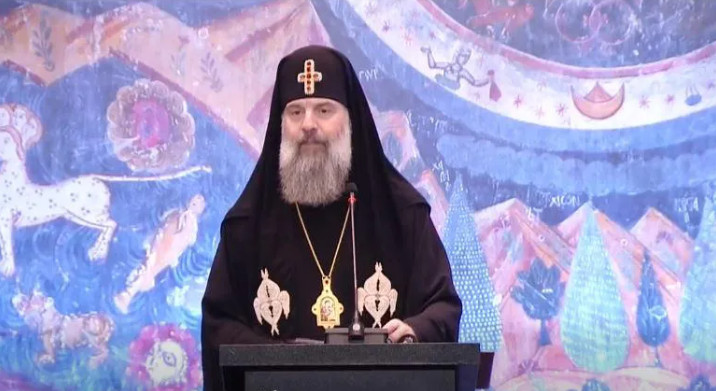
TBILISI, October 11 – Georgia’s political and religious leaders gathered in Tbilisi on Sunday for an international symposium marking 1,700 years since Christianity was declared the country’s state religion.
The symposium, titled “God, Homeland, Human,” opened at the Radisson hotel and was attended by Catholicos-Patriarch Shio III, Prime Minister Irakli Kobakhidze, Parliament Speaker Shalva Papuashvili and President Mikheil Kavelashvili. Georgian and foreign academics, historians, theologians, cultural figures and clergy are also taking part in the multi-day event.
Patriarch Shio III opened the event by warning that technological progress should not come at the cost of spiritual values.
“Technology should serve the human being and not the human being technology. Knowledge should not distance us from faith, progress should not make us forget spirituality,” he said.
He later addressed people living in Abkhazia and the Tskhinvali region, saying he hoped “brotherly unity and love” would eventually be restored, and also spoke of Georgians living abroad, saying the church continued to pray for them and awaited their return.
Prime Minister Kobakhidze said Christianity had shaped Georgia’s historical development and identity, and promised close cooperation between the state and the Georgian Orthodox Church in protecting that heritage.
“With close cooperation with the Church, we will firmly defend the heritage on which our national unity and development are based,” Kobakhidze said.
Parliament Speaker Papuashvili said Christianity had shaped Georgia’s cultural and political identity through centuries of foreign domination and periods when the country lost its statehood.
“Statehood can be temporarily lost, but if a nation preserves its identity, the possibility of restoring the state also remains,” he said.
President Kavelashvili went further, presenting what he called seven enduring values at the heart of Georgian state thinking: “God, homeland, human, native land, language, faith and family.”
He said those values form a foundation for personal identity and described them as an “existential shield” at a time when globalization and artificial intelligence are challenging traditional concepts of identity.