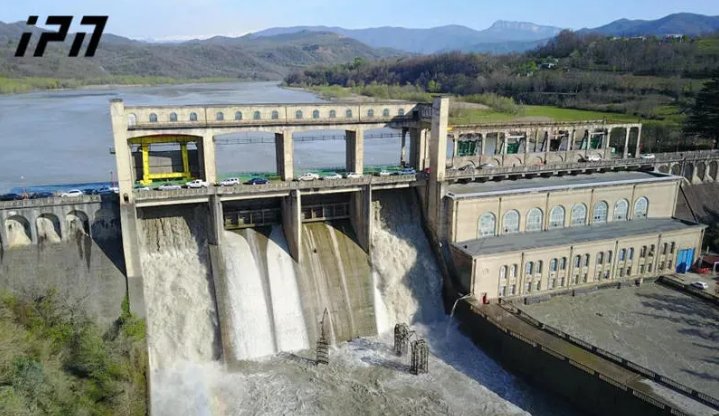
TBILISI, November 26 – Two new hydropower plants planned along Georgia’s central Mtkvari River have cleared a regulatory hurdle, after the National Environmental Agency issued environmental approvals on Thursday for the construction and operation of the Skra HPP and the Urbnisi HPP.
Both facilities will be built by the private company N-C Group 2022, which registered in 2022 and is fully owned by businessman Koka Kokolashvili, with Gocha Museliani listed as director. The projects form part of a proposed 13-plant “Mtkvari HPP Cascade” stretching across several municipalities between the villages of Kvishkheti in Khashuri and Ksani in Mtskheta.
But while the long-term cascade project spans multiple districts, the two plants approved this week will be located in the Gori and Kareli municipalities. Each will have its own 110 kV substation and medium-sized generating capacity. Skra HPP is planned at 14.8 MW, while Urbnisi HPP is set at 16.8 MW.
The approval does not grant an automatic green light for construction. Instead, the agency has attached a wide set of mandatory conditions aimed at limiting environmental and geological risks along the Mtkvari and its surrounding slopes.
For Skra HPP, the agency ordered continuous geological monitoring on nearby terrain throughout construction and operation. The instruction focuses heavily on one particularly sensitive area: the left bank of the planned reservoir, which sits on an old landslide body with active movement zones. The dam and substation sites, located at the confluence of the Mtkvari’s floodplain and a smaller unnamed ravine, must also receive special attention, as both slopes show signs of existing deformation.
If dangerous shifts are detected, the company is required to carry out preventive engineering measures to stabilize affected areas.
The Urbnisi project comes with its own restrictions. All earthworks must be conducted under the oversight of a certified archaeologist, a requirement often imposed along sections of the Mtkvari where the likelihood of buried historical material is high.
In addition, both projects must submit a forest restoration plan before any construction can begin. Because the developments will damage riparian (floodplain) woodland, the company has been ordered to plant 10 hectares of new forest as compensation.
The agency also requires a river-life monitoring program. The company must provide a detailed plan for monitoring the fish passage system, including how its effectiveness will be measured. Baseline ichthyological and macroinvertebrate surveys of the Mtkvari must be completed before ground-breaking so that post-construction data can be compared over the first five years of operation.
Although the two newly approved plants are modest in size, they form early pieces of a much larger and more controversial blueprint. The full Mtkvari HPP Cascade envisions 208 MW of cumulative capacity across 13 run-of-river stations. Planned sites span five municipalities and include facilities named Ksani 1, Ksani 2, Grakali, Skra, Kareli, Urbnisi, Gomi 1, Gomi 2, Kvishkheti 1, Kvishkheti 2, Akhalsofeli, Kaspi, and Osiuri.
Supporters of the cascade argue it could strengthen Georgia’s domestic energy production. Critics, including environmental and local groups in past debates on river-based hydropower, often point to the cumulative impact of multiple weirs, altered flow patterns and newly created access roads across long stretches of the same river.