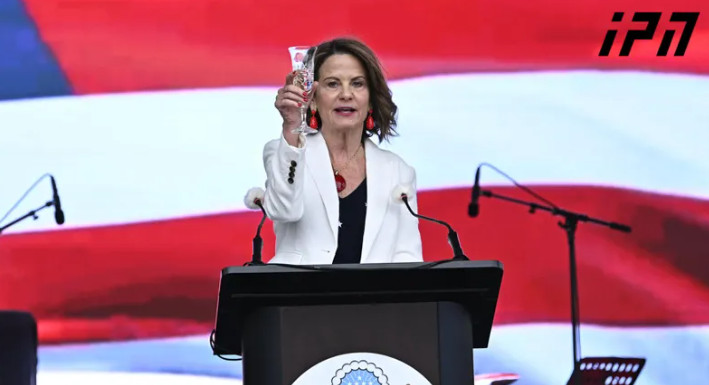
TBILISI, DFWatch–US Ambassador Robin Dunnigan, who recently announced her retirement, said the tone of a private letter sent to Washington by Georgian Dream leadership was “threatening, insulting, and unserious,” and that it had been very poorly received in the US capital.
Dunnigan added that she had spoken with several US senators who expected a sanctions bill to pass the U.S. Congress. The ambassador announced her retirement in June, a move which sparked speculation due to the embassy’s unexplained withholding of a letter from a letter from Donald Trump to Georgian President Mikheil Kavelashvili.
Many Western countries, the U.S. included, have signaled a wait and see approach to who is the legitimate president of Georgia, as ex-President Salome Zourabichvili continues to claim that role, six months after leaving office. Trump’s letter in connection with Georgia’s national day was therefore seen as tacit recognition of Kavelashvili – in contrast to the Tbilisi embassy’s approach till then.
There is growing concern in Tbilisi about the bipartisan bill known as the MEGOBARI Act (“megobari” means “friend” in Georgian). The bill was approved by the US House of Representatives in May and proposes targeted sanctions against individuals deemed responsible for undermining democracy in Georgia or aligning with the interests of Russia, China, or Iran.
While the ruling Georgian Dream (GD) party continues to offer reassurances that ties can be reset, Washington’s response has remained cautious and largely limited to embassy-level statements.
Georgian officials have acknowledged a “difficult period” in relations with the United States, amid growing tensions over democratic backsliding, foreign policy alignment, and the looming possibility of US sanctions.
Tengiz Sharmanashvili, deputy chair of Georgia’s parliamentary committee on defense and security, acknowledged the strain and described the MEGOBARI Act as just one of several possible measures Washington could take. He expressed hope that the US would eventually return to what he called a “fair relationship” with Georgia.
Professor Nika Chitadze of the International Black Sea University said Georgian Dream appears unwilling to accept responsibility for the deterioration in ties, but are likely genuinely worried about the prospect of sanctions.
Political analyst Petre Mamradze argued that criticism from the US is based on misinformation and accused American lawmakers of falsely portraying the Georgian government as aligned with authoritarian regimes. “They are blaming our government for things it hasn’t done,” he said.