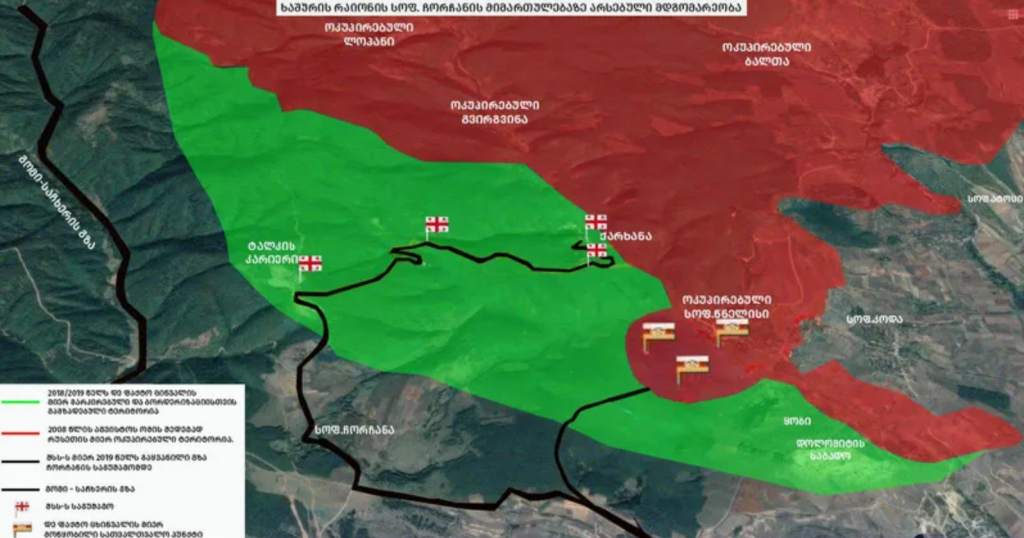
TBILISI, November 3 – The testimony of a former official has strengthened the case of exiled former prime minister Giorgi Gakharia.
Maia Tskitishvili, who was infrastructure and regional development minister at the time, testified Monday as a defense witness in the case over a Georgian police checkpoint established near the dividing line with Russian-backed South Ossetia.
Her account adds new detail to a case in which prosecutors have accused Gakharia, then interior minister, of making the decision to establish the checkpoint unilaterally and without coordinating it with senior government and security officials. Three former senior officials who testified in September, former prime minister Mamuka Bakhtadze, former defense minister Levan Izoria and former intelligence chief Davit Sujashvili, were cited by prosecutors as confirming they had not been consulted.
Tskitishvili said Gakharia called her in early August 2019, before the checkpoint was installed, and told her that fencing was under way in the Chorchana area and that there was a risk of losing territory. He asked whether her ministry could provide a bulldozer or tractor and open a road through the forest.
She said reports of “borderization” had already been circulating in the media and that yellow markings had appeared in the Chorchana forest from January 2019, which she understood as a possible precursor to barbed-wire fencing.
Tskitishvili said Gakharia described the matter as urgent. She replied that road construction would normally require a tender and could not be arranged immediately. Gakharia then asked her to coordinate with his deputy, Levan Kakava. Tskitishvili said Kakava later told her he would handle the matter and the Infrastructure Ministry was not directly involved.
She also said she did not remember Gakharia specifically mentioning plans for a police checkpoint during their conversation and learned about the post only after it was reported in the media.
The checkpoint became the center of a tense standoff in August 2019. South Ossetian authorities demanded its removal, deployed additional forces and later established their own posts nearby. Georgian officials at the time insisted the checkpoint stood on territory controlled by Tbilisi.
Prosecutors now argue that Gakharia’s decision contributed to the loss of access to roughly 100 hectares of forest and brought additional homes under the control of the South Ossetian side. Gakharia faces up to 13 years in prison if convicted.
Tskitishvili told the court that the Chorchana issue was not discussed at ordinary government meetings. She said she had no conversation with then-prime minister Bakhtadze about the checkpoint and added that sensitive security matters would normally be handled through security institutions rather than at cabinet meetings.
Gakharia’s defense rejects the prosecution’s account and says the case is politically motivated. His party has also disputed the claim that the checkpoint caused territorial losses.