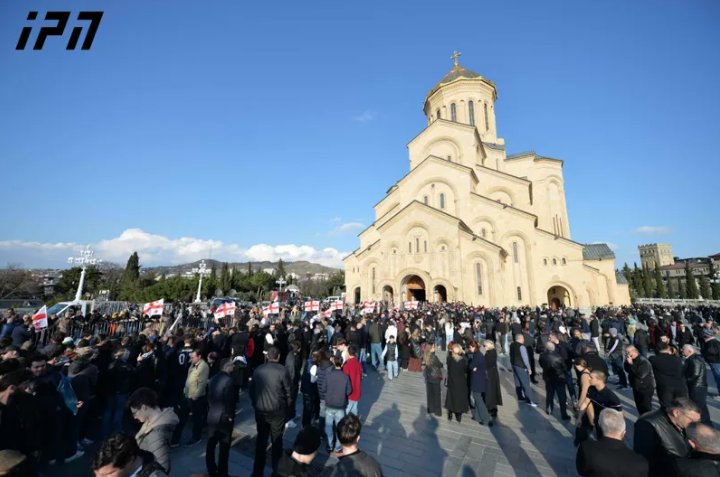
TBILISI, March 19 – Georgia’s mourning for Patriarch Ilia II moved into a public phase on Wednesday and Thursday, as the late church leader was transferred to Holy Trinity Cathedral in Tbilisi (pictured) and the cathedral was opened around the clock for mourners.
Ilia II, who led the Georgian Orthodox Church for nearly half a century, died late on Tuesday, March 17, at the age of 93. His death was officially announced at the Caucasus Medical Center by Metropolitan Shio, the patriarchal locum tenens. Georgia’s government then declared mourning, and state flags were ordered lowered on administrative buildings across the country.
The Patriarchate announced that the Holy Synod would meet on Wednesday, and that after the meeting Ilia II would be moved from the patriarchal residence to the Patriarchal Cathedral of the Holy Trinity.
By Wednesday evening, the transfer to Trinity Cathedral had taken place. Interpressnews reported that a memorial service for his soul was under way there, and later that night, the Georgian Orthodox Church’s administration, the Patriarchate, said the cathedral would remain open 24 hours a day so the public could come and pay tribute.
As of Thursday morning, the public memorial was still continuing inside Trinity Cathedral, according to Interpressnews. That turned the cathedral into the center of a national farewell for a man whose voice carried exceptional weight not only among Georgia’s religious community but in public life in general; opinion polls repeatedly showed him as the most trusted public figure in the country.
Metropolitan Shio described Ilia II as an “epochal” figure and said his passing was a major loss for the whole Orthodox world. He also said Georgia had gained a “heavenly protector.” Among the opposition, Coalition for Change leader Nika Gvaramia said Ilia II was loved not only by his own flock, but also by Georgians of other faiths, agnostics and atheists. Lelo leader Mamuka Khazaradze called him a figure who defined an era.