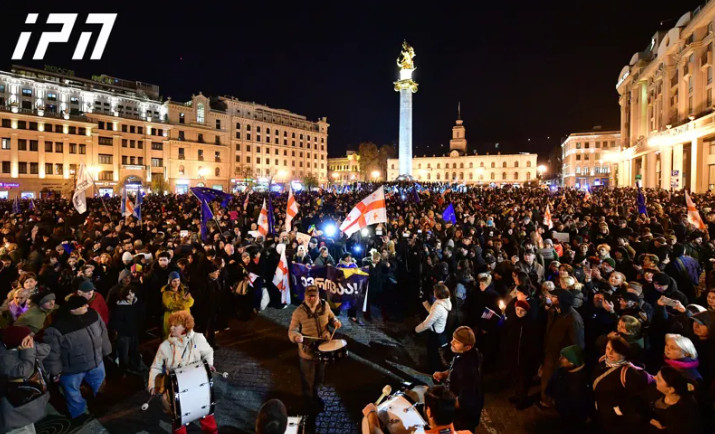
TBILISI, November 29 – A row has broken out among Georgia’s opposition parties over who decided to leave representatives of the United National Movement (UNM) off the list of speakers at Saturday’s anti-government rally in central Tbilisi.
Opposition supporters met at Freedom Square to mark two years since Prime Minister Irakli Kobakhidze announced a halt in further membership negotiations until 2028. The announcement followed a decision by the EU Commission the previous summer to not continue membership talks with Georgia.
Politicians, civil society activists and relatives of people jailed in connection with the protests addressed the crowd, but there were no speakers from UNM, the party of imprisoned former president Mikheil Saakashvili.
On Sunday afternoon, UNM leader Ana Tsitlidze demanded that members of the Opposition Alliance identify who had made that decision and under whose authority.
According to Tsitlidze, the alliance had drawn up the list of speakers, and UNM representatives had been in contact with members of the Akhali party and European Georgia leader Gigi Tsereteli about the issue.
She said discussions had been going on for two days, but that at least two parties in the alliance, Strategy Aghmashenebeli and Freedom Square, had apparently been unaware that UNM had been denied a speaking slot.
But Freedom Square leader Levan Tsutskiridze said preparations for the rally had been underway for some time and that UNM could have approached any of the organizers beforehand.
He argued that accommodating a request to speak once the rally was underway would have been unfair to others who also wanted to address the crowd. He pointed out that another party, Georgia First, had been given a speaking slot despite not participating in the common coordination format.
A second dispute concerned a banner featuring portraits of both Saakashvili and Bidzina Ivanishvili, the billionaire founder and honorary chairman of the ruling Georgian Dream party. The banner rejected both men as autocratic leaders.
UNM described the incident as a deliberate provocation and demanded that the alliance publicly distance itself from it.
Tsutskiridze said he disagreed with the banner, pointing out that Saakashvili was in prison while Ivanishvili remained wealthy and powerful.
Later on Sunday, the Federalists party argued that removing Ivanishvili from power must not be equated with bringing Saakashvili back and accused the UNM of undermining cooperation among opposition parties by portraying its political rivals as traitors or collaborators with the government.
UNM governed Georgia from the period following the 2003 Rose Revolution until its electoral defeat by Georgian Dream in 2012. The party has continued to be a leading voice among the opposition parties, despite shedding many of its former top people to splinter groups.
Those smaller UNM-alike parties, like European Georgia and the Federalists, have less of the reputational burden of UNM, which continues to be strongly disliked by about a third of the Georgian population.