TBILISI, March 7 – Georgia’s newly formed Opposition Alliance moved this week from launch mode into organization mode, holding meetings on protest strategy, non-recognition of the government’s legitimacy, and coordination with civil society groups.
The alliance was announced last Sunday, March 2, by a group of opposition parties that said they had agreed on a common strategy and joint rules of action. According to the agreement cited by Interpressnews, the bloc says its goal is to end what it calls Bidzina Ivanishvili’s “autocratic regime,” restore Georgia’s Euro-Atlantic course, and ensure democratic governance, security and public welfare. The document also says the parties will keep their own ideological identities while coordinating protest activity and communications.
On Wednesday, the alliance held its first working meeting. Nika Gvaramia, one of its leaders, said the group was discussing future plans, strategy and decision-making rules, including support for the protest movement. He said the first immediate step should be the release of what the opposition describes as political prisoners.
A day later, on Thursday, the alliance issued a new statement after parliament passed a law that, according to the opposition, threatens criminal punishment for citizens who call the ruling system illegitimate. In that statement, the alliance said it would continue a coordinated policy of non-recognition, both inside Georgia and abroad, and repeated its claim that the current authorities lack political legitimacy.
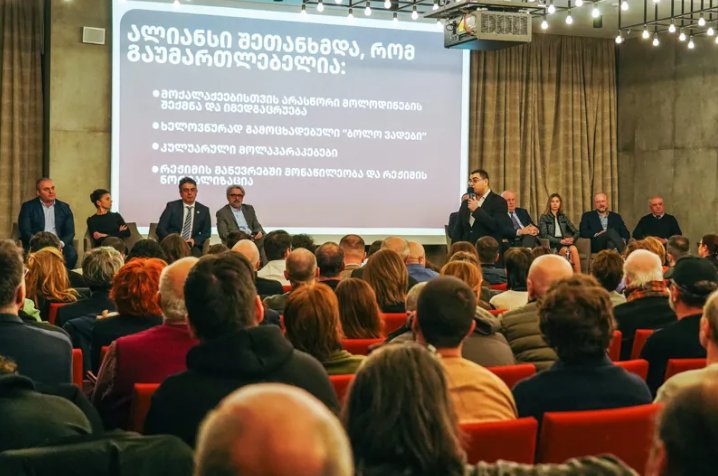
The latest step came on Saturday, when the alliance met with civil society and protest groups. Before the meeting, Gvaramia said civic groups and protest activists are the force that sustains the protest movement. Other alliance figures said in recent days that the bloc plans broader coordination with major civil organizations, wants to expand protest activity, and is trying to present itself as a democratic alternative to the ruling Georgian Dream party.
The alliance has also drawn criticism from several directions. Ruling party lawmakers dismissed it as little more than a repackaging of the United National Movement and predicted that the effort would fail like previous opposition unity projects.
Not all opposition groups have joined either. Leaders from Lelo said they are ready for cooperation on specific issues but want to remain a separate electoral force, while figures from the For Georgia party argued that the new bloc is built around boycott politics and the fallout from the October 4 confrontation, not a convincing plan to defeat Georgian Dream. Ana Dolidze, leader of the For the People party, also criticized the alliance, calling the idea politically harmful.