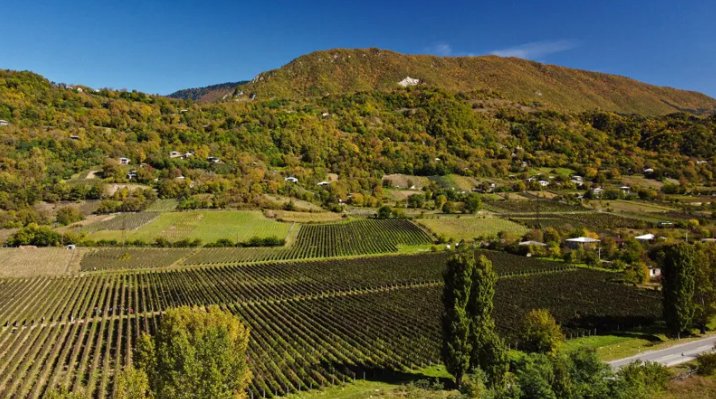
TBILISI, October 6 – Khvanchkara is known as one of Stalin’s favorites, and in the remote mountain region of Racha, in northern Georgia, the annual ‘rtveli’ is in full swing, a cultural ritual to harvest the grapes for the famous wine.
So far, 120 tons of grapes have been processed in Ambrolauri municipality, according to Georgia’s National Wine Agency. Around 110 tons of the total are of the Aleksandrouli and Mujuretuli varieties, used to make the country’s best-known semi-sweet red wine, Khvanchkara.
The government has launched a subsidy program to help private wineries buy and process grapes from Racha’s Khvanchkara microzone. Under the scheme, any wine company purchasing at least three tons of Aleksandrouli or Mujuretuli grapes and paying local growers no less than 8 lari (about US$3) per kilogram will receive a state subsidy of 4 lari per kilogram.
Khvanchkara, produced only in this part of Racha-Lechkhumi, holds a protected designation of origin. To ensure authenticity, ampelographers — grape specialists — are stationed at every collection point to monitor the process. Special checkpoints have also been set up on roads leading into the region to prevent grapes from other areas being mixed in, which could compromise the purity of the local wine.
A harvest coordination headquarters has been established in Ambrolauri to oversee this year’s “Rtveli 2025” grape collection. Farmers and producers can call the Ministry of Environmental Protection and Agriculture’s hotline at 1501 for assistance or information.
The National Wine Agency estimates that this year’s harvest in Racha-Lechkhumi will total between 1,500 and 2,000 tons.
Meanwhile, Georgia’s main winemaking region, Kakheti, is also deep into its harvest. By October 6, around 214,000 tons of grapes had been processed there, a reminder of the vast difference in scale between the industrial lowlands of eastern Georgia and the small, highland vineyards of Racha, where nearly every grape is handpicked.