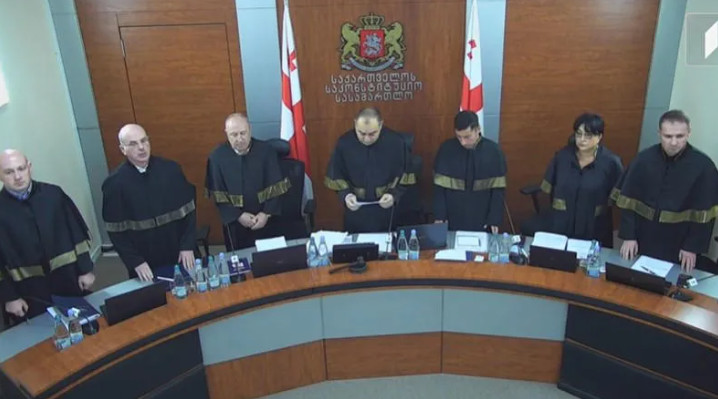
TBILISI, October 27 – Georgia’s Constitutional Court is continuing hearings on a lawsuit seeking to ban five opposition parties, with the case moving from procedural disputes into arguments over whether the groups acted together against the constitutional order.
The case opened on October 21 before a seven-judge panel. It was filed by 88 members of parliament and targets the United National Movement, Coalition for Change, Strong Georgia-Lelo, the Federalists and former PM Gakharia’s For Georgia party.
The lawsuit relies on Article 23 of Georgia’s Constitution, which prohibits parties seeking to overthrow or violently change the constitutional order, undermine independence or territorial integrity, or promote war, violence or certain forms of hatred. Only the Constitutional Court can impose a party ban.
The plaintiffs’ case reaches back to the United National Movement’s rule under President Mikheil Saakashvili in 2004–2012. It cites systematic abuses of power involving prisons, property rights and media freedom. It also alleges subsequent attempts to overthrow elected authorities, including the June 2019 confrontation outside parliament, and treats the opposition’s repeated rejection of election results and government legitimacy as evidence of a continuing unconstitutional strategy.
In addition to UNM, four other parties are also targeted by extending the same argument. The plaintiffs point to other parties’ leaders having served in its government or political structures, alongside later alliances and shared positions. They argue that the five groups function as a single political organisation despite their separate registrations.
The opposition parties in question dispute that collective treatment, arguing that cooperation and criticism of the government do not establish grounds for banning distinct parties.
Archil Gorduladze, a Georgian Dream lawmaker and chairman of parliament’s Legal Affairs Committee, said Tuesday that the case was not about political cooperation itself. He said the parties were accused of cooperating in actions harmful to the country and contrary to the Constitution.
He also argued that a party’s failure to distance itself from violent actions can have legal consequences, citing European Court of Human Rights case law. Gorduladze said the plaintiffs are asking only for the parties to be banned and are not seeking automatic removal of MPs from parliament.
The opposition has challenged both the evidence and the way the hearings are being conducted.
On the opening day, opposition representatives asked for some or all of the judges to be removed from the case, but the court rejected the requests.
Gakharia for Georgia later asked for the hearing to be delayed by one month, arguing that it had not been given the required time to prepare its response. The court rejected that request as well.
Party representative Berdia Sichinava said Tuesday that Georgian Dream had failed to show with facts and evidence why his party’s activity violated the Constitution.
Strong Georgia-Lelo leader Badri Japaridze called the case political persecution and said his party would use all available legal means to challenge it.
The hearings were continuing Tuesday, with the court still hearing explanations from the parties.